Introduction
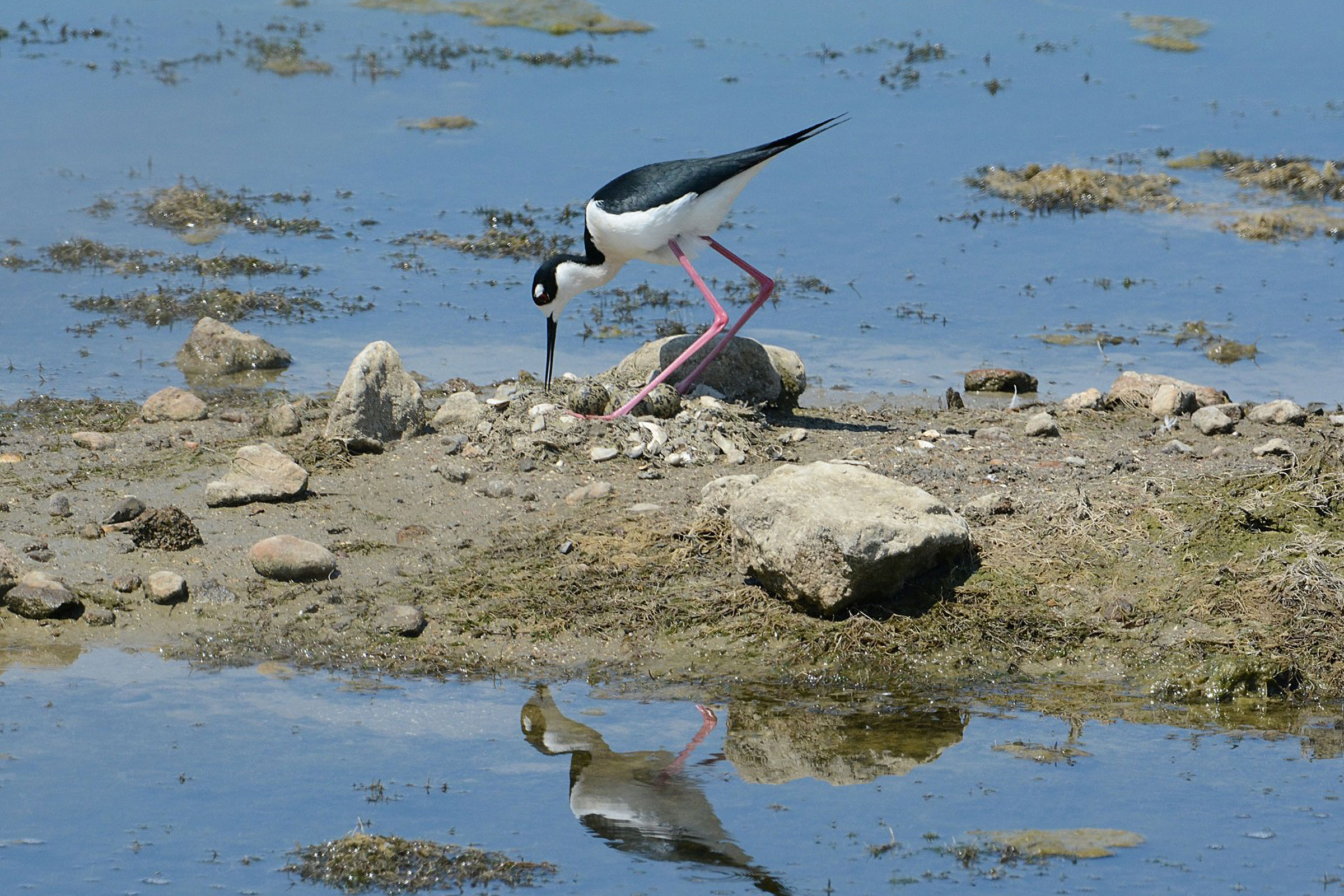
Black-necked Stilts are long-legged shorebirds that breed along the Atlantic Coast as far north as Delaware. In Virginia, breeding is confined to a small area near Hampton Roads and on the Eastern Shore. Stilts were not documented during the First Atlas but have been reported nearly annually in Virginia’s Coastal Plain since 1971, although confirmed breeding records are sparse (Rottenborn and Brinkley 2007). They nest in shallow wetlands with limited vegetation, such as lagoons, sparse saltmarshes, and mudflats (Robinson et al. 2020).
Breeding Distribution
During the Second Breeding Bird Atlas, there were too few breeding observations to develop occupancy models for the Black-necked Stilt. Please see the Breeding Evidence section for more information on its breeding distribution.
Breeding Evidence
Black-necked Stilts were confirmed breeders in five blocks in Accomack County and the city of Portsmouth, and in the latter, they were only found on Craney Island (Figure 1). They were probable breeders only in Accomack. The species was not reported during the First Atlas.
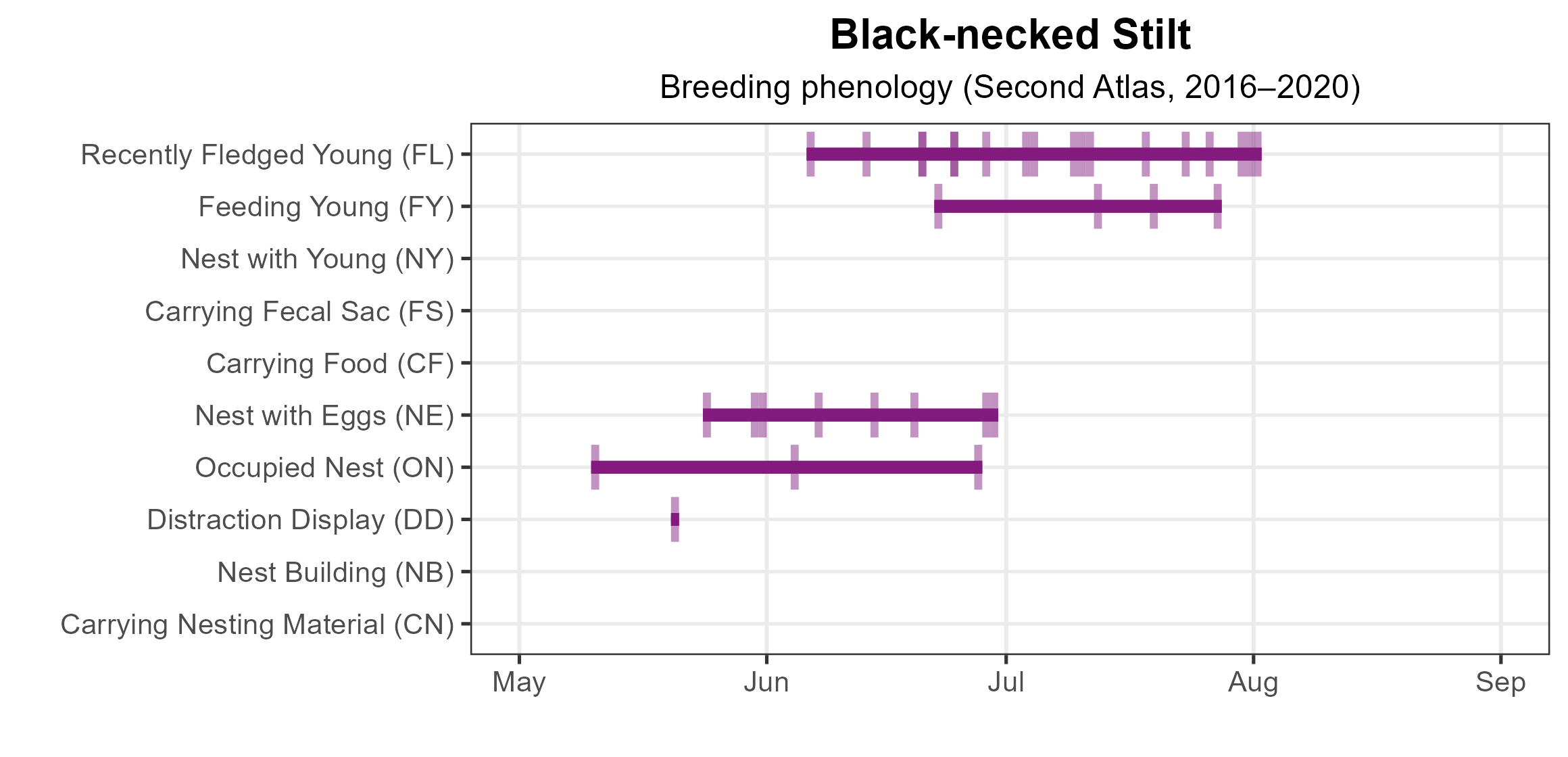
The earliest breeding confirmation was recorded when an occupied nest was observed on May 10 (Figure 2). Breeding was also confirmed through observations of nests with eggs (May 24 – June 29), recently fledged young (June 6 – August 1), and adults feeding young (June 22 – July 27). A distraction display was observed on May 20.
For more general information on the breeding habits of this species, please refer to All About Birds.

Population Status
As a very uncommon breeder in Virginia, a lack of detections during the point count surveys prevented the development of an abundance model for the Black-necked Stilt. Similarly, this species is not readily detected by the North American Breeding Bird Survey, which relies on roadside counts, so no estimates of population trends are available.
Conservation
Although rare in Virginia, Black-necked Stilt populations have remained stable throughout their range, and the species is not of conservation concern in the state. As such, there are no conservation projects dedicated to the Black-necked Stilt in Virginia.
Interactive Map
The interactive map contains up to six Atlas layers (probability of occurrence for the First and Second Atlases, change in probability of occurrence between Atlases, breeding evidence for the First and Second Atlases, and abundance for the Second Atlas) that can be viewed one at a time. To view an Atlas map layer, mouse over the layer box in the upper left. County lines and physiographic regional boundaries (Mountains and Valleys, Piedmont, and Coastal Plain) can be turned on and off by checking or unchecking the box below the layer box. Within the map window, users can hover on a block to see its value for each layer and pan and zoom to see roads, towns, and other features of interest that are visible beneath a selected layer.
View Interactive Map in Full Screen
References
Robinson, J. A., J. M. Reed, J. P. Skorupa, and L. W. Oring (2020). Black-necked Stilt (Himantopus mexicanus), version 1.0. In Birds of the World (A. F. Poole and F. B. Gill, Editors). Cornell Lab of Ornithology, Ithaca, NY. https://doi.org/10.2173/bow.bknsti.01.
Rottenborn, S. C., and E. S. Brinkley (Editors) (2007). Virginia’s birdlife: An annotated checklist. 4th edition. Virginia Society of Ornithology.