Written By: Sergio Harding and Austin Kane
Species Accounts are presented in taxonomic order for 203 species. Species that were not documented during the Second Atlas but that are known as historic breeders in the Commonwealth are treated separately in the Results.
The Species Accounts provide a summary of the status of each breeding bird species in Virginia based on what was learned through the Second Atlas and on supplementary sources of information. The accounts are data-rich, including maps, charts, and graphs, in addition to narratives that lend a clear interpretation to give the reader an understanding of how each species is faring in Virginia.
Detailed natural history information for each species was purposely not included as this is already well presented by other online sources. For such information, consult Cornell Lab of Ornithology’s Birds of the World and All About Birds, Audubon’s Guide to North American Birds, or American Bird Conservancy’s Bird Library. Species profiles for a selection of high-priority species can also be found on the Virginia Department of Wildlife Resources website.
Each Species Account is organized into sections, which vary in length depending on the species. Accounts of rare species for which the Second Atlas produced a limited number of field records may have a stronger focus on historical occurrence and highlight individual breeding records. The account sections are summarized below.
Header
The header includes species names, conservation status, Species Account primary author(s), name of sponsor(s) and dedication, and photographs.
The species names – common (in English) and scientific (in Latin) – follow the American Ornithological Society’s Checklist of North and Middle American Birds, 66th supplement (Chesser et al. 2025).
Species conservation status shows whether a species is listed as Threatened or Endangered in the state of Virginia and/or at the federal level and whether it is identified as a Species of Greatest Conservation Need (SGCN) or Assessment Priority Species in the 2025 Virginia Wildlife Action Plan. SGCNs are noted with their corresponding tier and Conservation Opportunity Rank (a, b, or c):
- Tier I-Critical Conservation Need,
- Tier II-Very High Conservation Need,
- Tier III-High Conservation Need, and
- Tier IV-Moderate Conservation Need.
For more information on the Wildlife Action Plan and species tiers, visit Species of Greatest Conservation Need.
Sponsorship. The Virginia Society of Ornithology’s (VSO) Sponsor-a-Species program was an important part of raising the funds to pay for publication of the Second Atlas. Each species for which the Second Atlas has a Species Account was offered for sponsorship, with varying donation levels. Sponsors are shown on their sponsored Species Account, along with the name of any person or organization they wish to honor. We thank these donors for their critical support for the Second Atlas.
Photographs show a typical breeding individual of the species or breeding male and female for sexually dimorphic species (where the sexes have noticeably different physical characteristics such as obvious differences in plumage). While all photos were taken during each species’ breeding season, they do not necessarily depict individuals that bred in Virginia. This is because it is difficult to distinguish between migrants and breeders without documenting breeding evidence, and quality photos of individuals within their Virginia breeding range are difficult to obtain for less common, range-restricted breeders (ex. montane species). Additional photos illustrate evidence of breeding (e.g., nests, parent feeding young, etc.). With only a few exceptions, all photos were taken in Virginia, and their location (including city or county) is noted in the caption with the photographer’s name.
Introduction
The Introduction presents interesting facts about each species, such as unusual or unique aspects of its natural history, habitats, taxonomy, breeding range, or a distinct song or behavior. Where possible, Virginia-specific information is included.
Breeding Distribution
This section presents maps and an accompanying narrative about a species’ breeding distribution within the state for both the First and Second Atlases (examples are Figures 1 and 2). The maps are based on occupancy models that predict the probability of a species occurring within individual Atlas blocks. This modeling approach has an advantage over distribution maps that are based on raw data because it accounts for variation in survey effort among blocks, which can affect the number of species detected, and this approach predicts the probability of occurrence in under-surveyed and unsurveyed blocks. Values of probable occurrence range from 0 and 1, which can be interpreted as a 0% to 100% chance of a species occurring in, or occupying, a block. In the map scale, this probability ranges from very low (0 to 0.2) to very high (0.8 to 1), with the remaining values corresponding to low, moderate and high probabilities of occurrence.
Gray areas in the First and Second Atlas maps represent areas outside of a species’ core breeding range, which were not modeled. White blocks in the First Atlas maps represent blocks that were not surveyed during that Atlas and could not be modeled via the coarser modeling approach used for the First Atlas (see Analytical Methods for more information).
All maps in the Species Accounts display both county boundaries and physiographic regions. The latter are based on delineations used in the 2005 Virginia Wildlife Action Plan and include the Coastal Plain (Eastern Shore to the Fall Line), Piedmont (the Fall Line west to and including the foothills of the Blue Ridge Mountains), and Mountains and Valleys (Blue Ridge to the state’s western border).
Second Atlas distribution maps were produced for 137 species. Second as well as First Atlas distribution maps could not be produced for species with too few breeding records (rare and uncommon breeders, as well as less common species). In addition, First Atlas distribution maps could not be generated for some habitat generalist species such as Blue Jay, Indigo Bunting, Northern Cardinal, and others. These species inhabit a range of habitats and have statewide distributions such that the coarse models used for the First Atlas could not identify variables that were important in predicting their distribution (see Analytical Methods for more information). For these species, the breeding evidence maps provide a fairly accurate picture of their distribution during the First Atlas (see Breeding Evidence section).

Figure 1:Black-throated Blue Warbler breeding distribution based on probability of occurrence (Second Atlas, 2016–2020). This map indicates the probability that this species will occur in an Atlas block (an approximately 10 mi2 [26 km2] survey unit) based on environmental (including habitat) factors and after adjusting for the probability of detection (based on variation in survey effort among blocks). Blocks in gray lie outside the core range of the species.
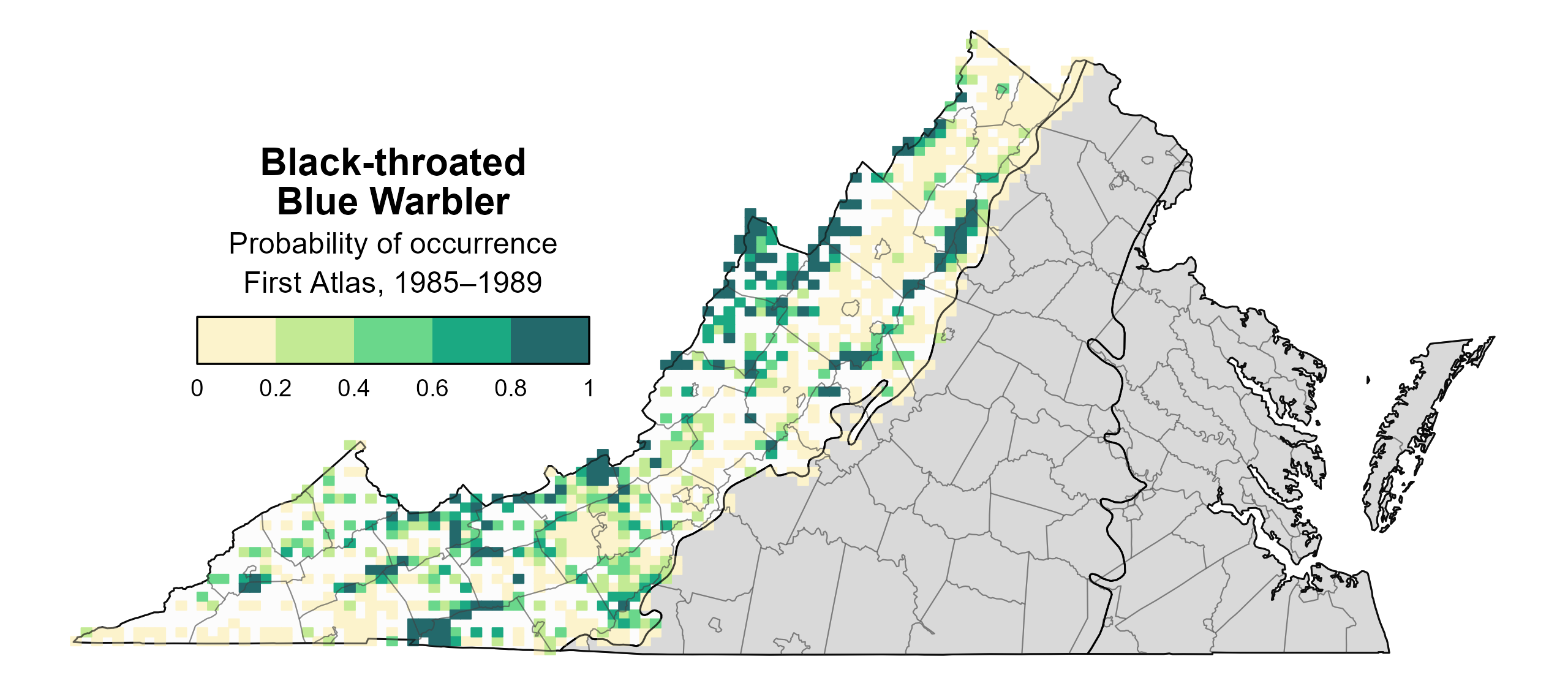
Figure 2: Black-throated Blue Warbler breeding distribution based on probability of occurrence (First Atlas, 1985–1989). This map indicates the probability that this species will occur in an Atlas block (an approximately 10 mi2 [26 km2] survey unit) based on environmental (including habitat) factors and after adjusting for the probability of detection (based on variation in survey effort among blocks). Blocks in white were not surveyed during the First Atlas and were not modeled. Blocks in gray are outside the species’ core range and were not modeled.
Where a species is distributed on the landscape is closely tied to habitat, among other factors. Given this, occupancy models were based on volunteer-collected Atlas data and their relationship to variables reflecting habitat and environmental data for the blocks (e.g., forest cover, annual rainfall, etc.). The narrative discusses the significant habitat variables that explain a species’ distribution based on model results. For example, a particular species may be more likely to occur in blocks with higher proportions of forest cover.
To learn more about these relationships, a link is provided to graphs that show the significant relationships between all environmental variables (including the habitat variables as well as climate variables) and a species’ probability of occurrence for the Second Atlas. Importantly, some of these variables may not be discussed in the Species Account narrative, which focuses on the habitat variables, as noted above. While climate variables (e.g., number of freezing days in a year) can influence habitat distribution and were essential to building the distribution models, their effects on probability of occurrence are more indirect and less interpretable. In addition, the text does not discuss habitat variables that have a weak relationship with probability of occurrence (e.g., a flat line in the graph), even though they were statistically significant. Finally, habitat variables that are significant in the models due to their interactions with other variables but are otherwise inconsistent with the known habitat preferences of a species are not discussed. These variables are likely acting as a stand-in for some other correlated, but unmeasured, variable that would have a more interpretable relationship with the species. See Analytical Methods for more details about the modeling process and the habitat and environmental variables.
Maps of the change in a species’ distribution between the First and Second Atlases are presented for 82 species that have distribution maps for both Atlases (an example is Figure 3). These maps represent the change in the likelihood that a species occurs in individual Atlas blocks between Atlas periods. The change values are derived on a block-by-block basis by subtracting the probability of occurrence for a block in the First Atlas from the probability of occurrence for that block in the Second Atlas.
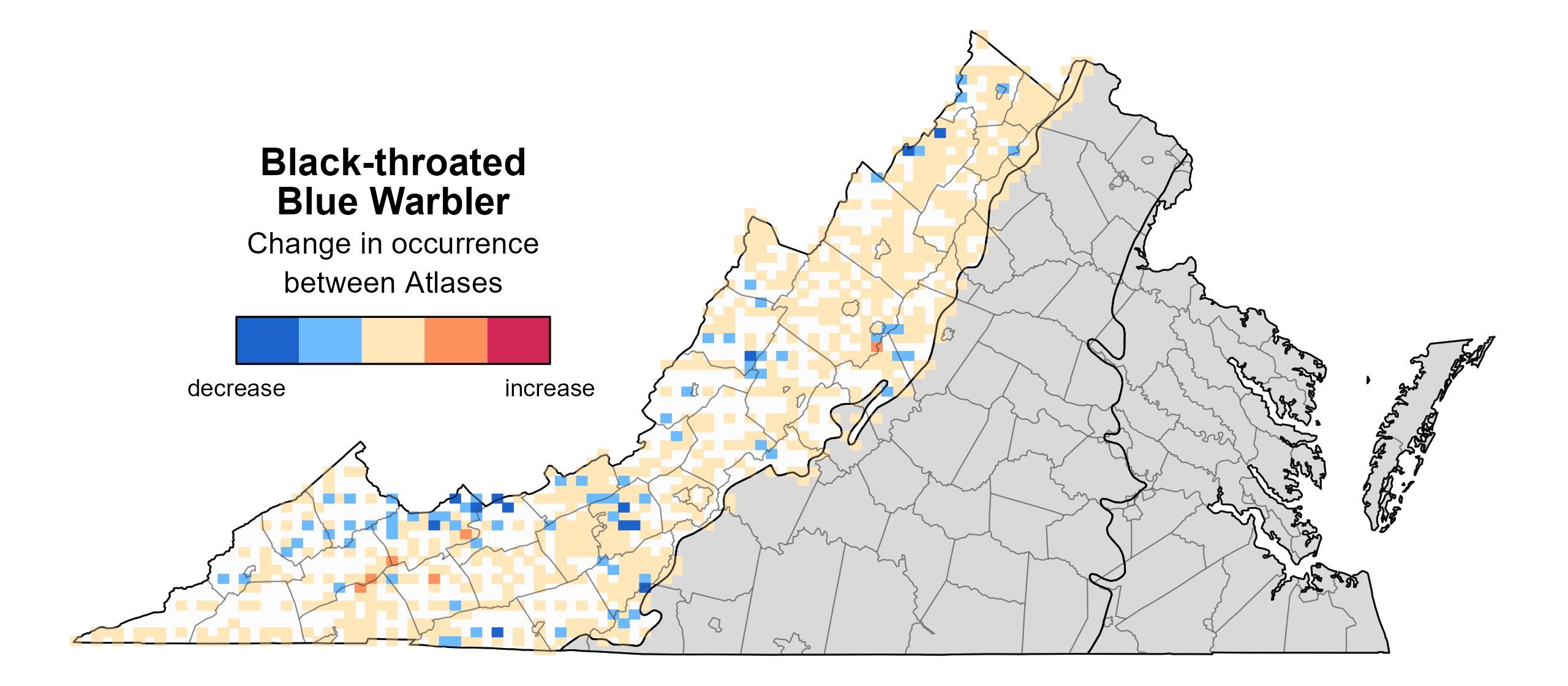
Figure 3: Black-throated Blue Warbler change in breeding distribution between Atlases (1985–1989 and 2016–2020) based on probability of occurrence. This map indicates the change in the probability that this species will occur in a block (an approximately 10 mi2 [26 km2] survey unit) between Atlas periods. Blocks with no change (tan) may have constant presence or constant absence. Blocks in white were not surveyed during the First Atlas so were not modeled. Blocks in gray are outside the species’ core range and were not modeled.
On these maps, change is displayed as substantial decrease (dark blue, -1.0 to -0.5), moderate decrease (light blue, -0.5 to -0.3), no change (tan, -0.3 to +0.3), moderate increase (orange, +0.3 to +0.5), and substantial increase (red, +0.5 to +1.0). No estimation of change was possible for the blocks in white, which were not surveyed during the First Atlas. The blocks in gray lie outside the core range of the species and were not modeled.
Tan blocks indicate no change in occurrence between Atlases and can signify constant presence (i.e., species is predicted to have the same positive likelihood of occurrence in that block in both Atlases) or constant absence (i.e., species is predicted not to occur in that block in either Atlas). Therefore, for blocks and broader geographic areas that indicate no change, it is important to refer to the First and Second Atlas distribution maps to properly assess whether a species occurs in that area.
While the accompanying narrative lends interpretation to the maps, for most species it refrains from explaining what factors may be driving changes in breeding occurrence, as such explanations would be largely speculative. While local- and landscape-level changes in habitat between the two Atlases are likely contributing to such changes, a formal analysis of land use change between Atlases has not been conducted. Additional factors not directly related to habitat, or taking place away from the breeding grounds, can also ultimately drive changes in a species’ breeding occurrence.
Breeding Evidence
This section provides an overview of the raw block-level data collected by Atlas volunteers during both Atlases. Breeding evidence maps complement the distribution maps by displaying the highest breeding category (possible, probable and confirmed breeders) reported for each block during the Atlas period (an example is Figure 4). These categories are described in the Atlas Methods. The ‘observed’ category is not mapped.
The map legend includes the number of blocks in which a species was recorded for each of the three breeding categories. Maps are included for all species for both the First and Second Atlases, except for those that were not documented during the First Atlas (see Results).
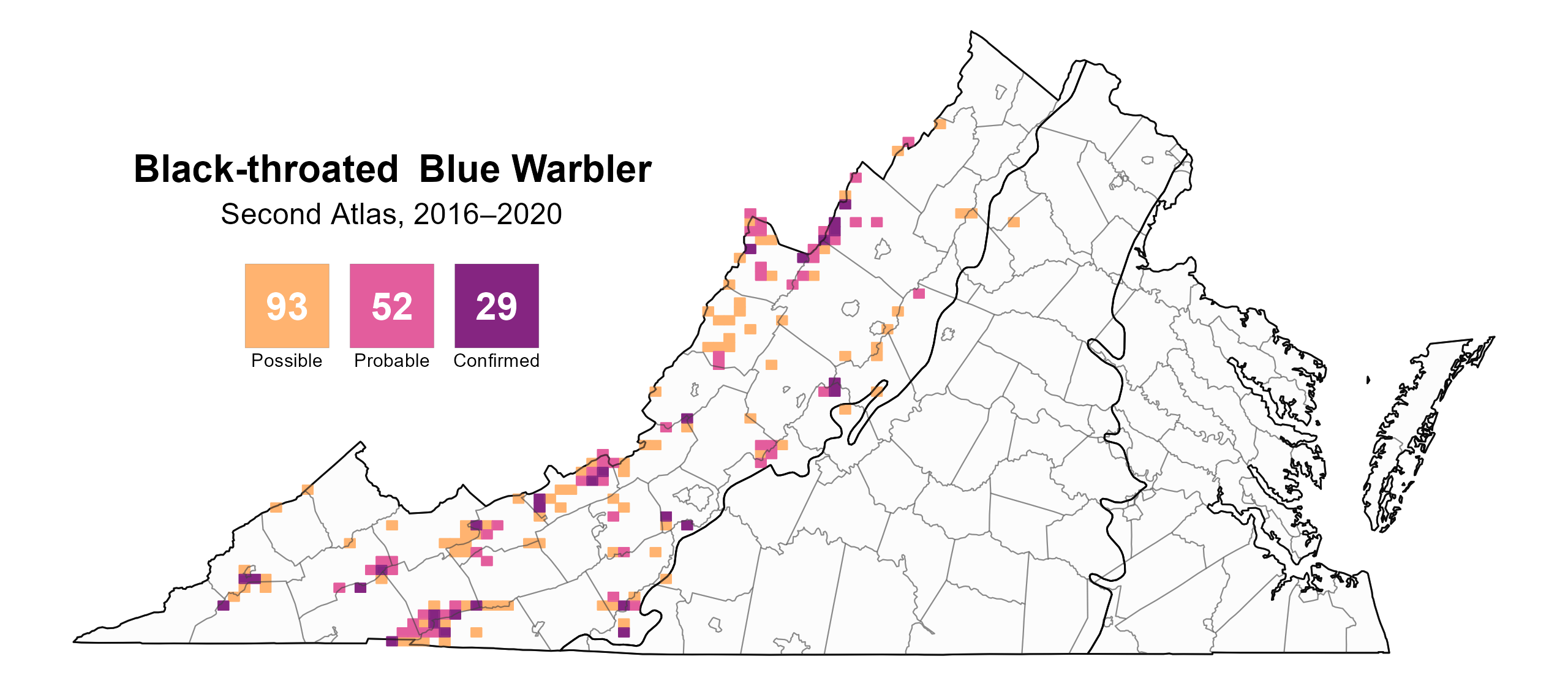
Figure 4: Black-throated Blue Warbler breeding observations from the Second Atlas (2016–2020). The colored boxes illustrate Atlas blocks (approximately 10 mi2 [26 km2] survey units) where the species was detected. The colors show the highest breeding category recorded in a block. The numbers within the colors in the legend correspond to the number of blocks with that breeding evidence category.
Although the breeding evidence maps provide useful information, they do not provide an accurate picture of species distributions because of the degree to which survey effort varied among blocks; blocks with lower survey effort tended to have fewer species reported. In addition, overall survey effort in the Second Atlas was substantially higher than in the First Atlas. For these reasons, a direct comparison of breeding evidence between Atlases would not be meaningful, and we therefore do not include maps highlighting the change in breeding evidence. For information on species distribution and change in likelihood of occurrence, refer to the maps in the Breeding Distribution section.
Where data were insufficient to develop breeding distribution maps (66 species), the breeding evidence maps provide the best Atlas-derived information on a species’ distribution. For exceptionally rare or uncommon species, the narrative often includes additional information on the locations where breeding was confirmed or probable, for the purpose of providing a public record. For all species, the narrative notes the number of blocks and counties (counties include both counties and independent cities) in which a species was recorded as a confirmed and/or probable breeder.
Finally, a chart is included that summarizes Second Atlas data to illustrate the timing of the behaviors (phenology) associated with breeding confirmations (e.g., nests and fledged young), including the first and last dates reported for each behavior (example is Figure 5). The most frequently reported breeding behaviors for the species are noted in the narrative. These behaviors, represented by breeding codes, are explained in more detail in the Atlas Methods.
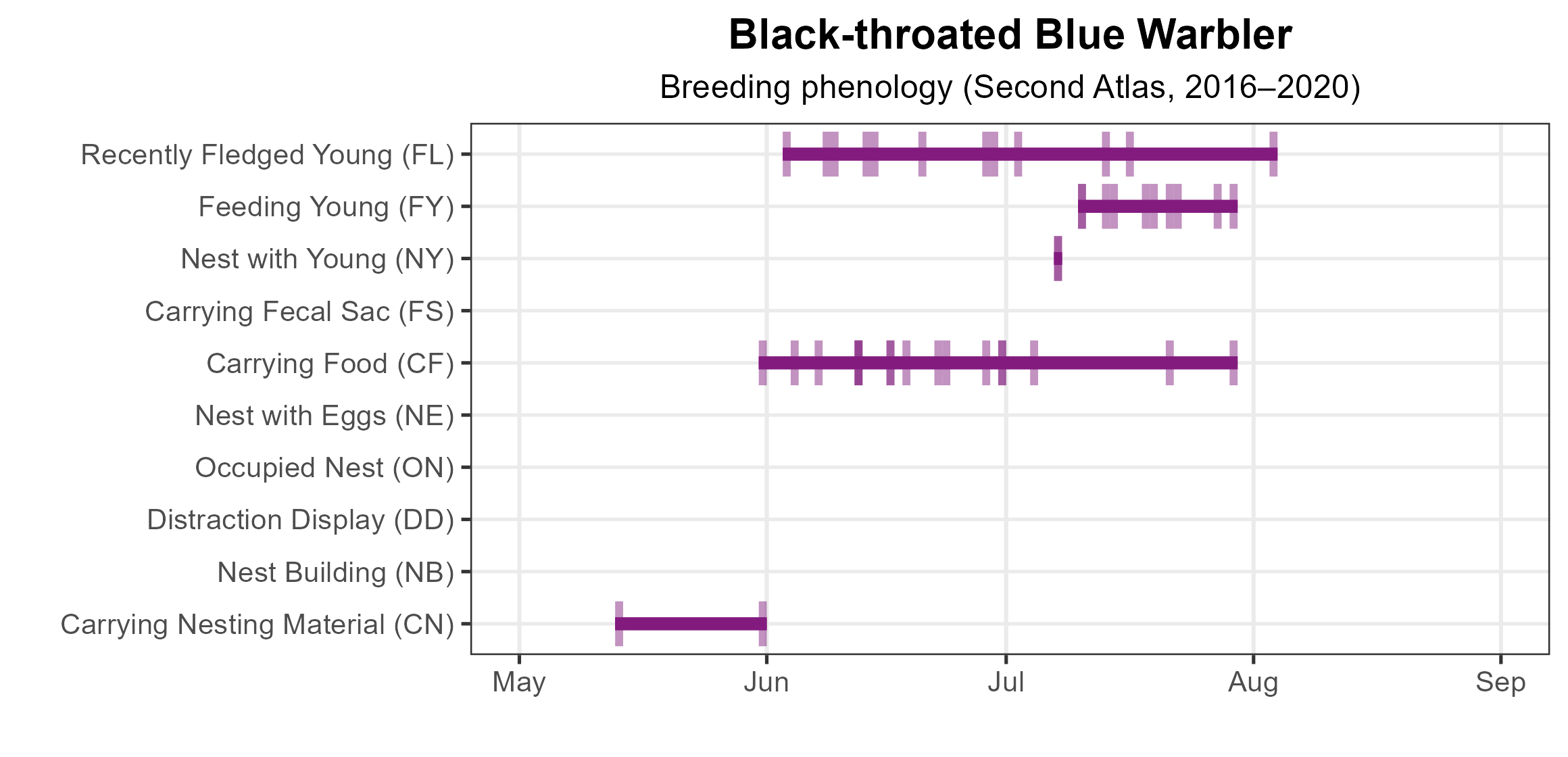
Figure 5: Black-throated Blue Warbler phenology: confirmed breeding codes. This graph shows a timeline of breeding behaviors. Tick marks represent individual observations of the behavior.
Population Status
This section includes a map of the relative abundance of a species, a population estimate, and population trends to provide an overall understanding of the population status of each species include in the Second Atlas.
Relative Abundance and Population Estimates
Relative abundance maps and population estimates are based on abundance models that were generated for the 103 species with sufficient data. These models used data from Atlas point count surveys conducted by field technicians and the same habitat and environmental variables as the occupancy models (see Analytical Methods). Species with sufficient data tend to be species that are more common, as well as those that are more easily detected during point counts, including songbirds and other vocal non-singing birds such as woodpeckers and crows, as well as fairly visible species such as raptors and some wading birds.
Population estimates are rounded to the nearest thousand and represent the predicted number of detectable individuals, as well as the upper and lower range within which there is 95% confidence that the true population size falls.
Relative abundance maps supplement the distribution maps by indicating where on the landscape a species is more or less abundant. The maps are based on the estimated number of individuals per 0.4 mi2 (1 km2) (an example is Figure 6). While the abundance maps are reliable in their assessment of areas of high and low abundance for a species, the abundance estimates themselves are less reliable when taken as absolute values. Therefore, we only display descriptors of abundance (low to high) on the maps. Because the abundance values are relative, a “high” value for one species will not represent the same estimated number of individuals as a “high” value for another species.
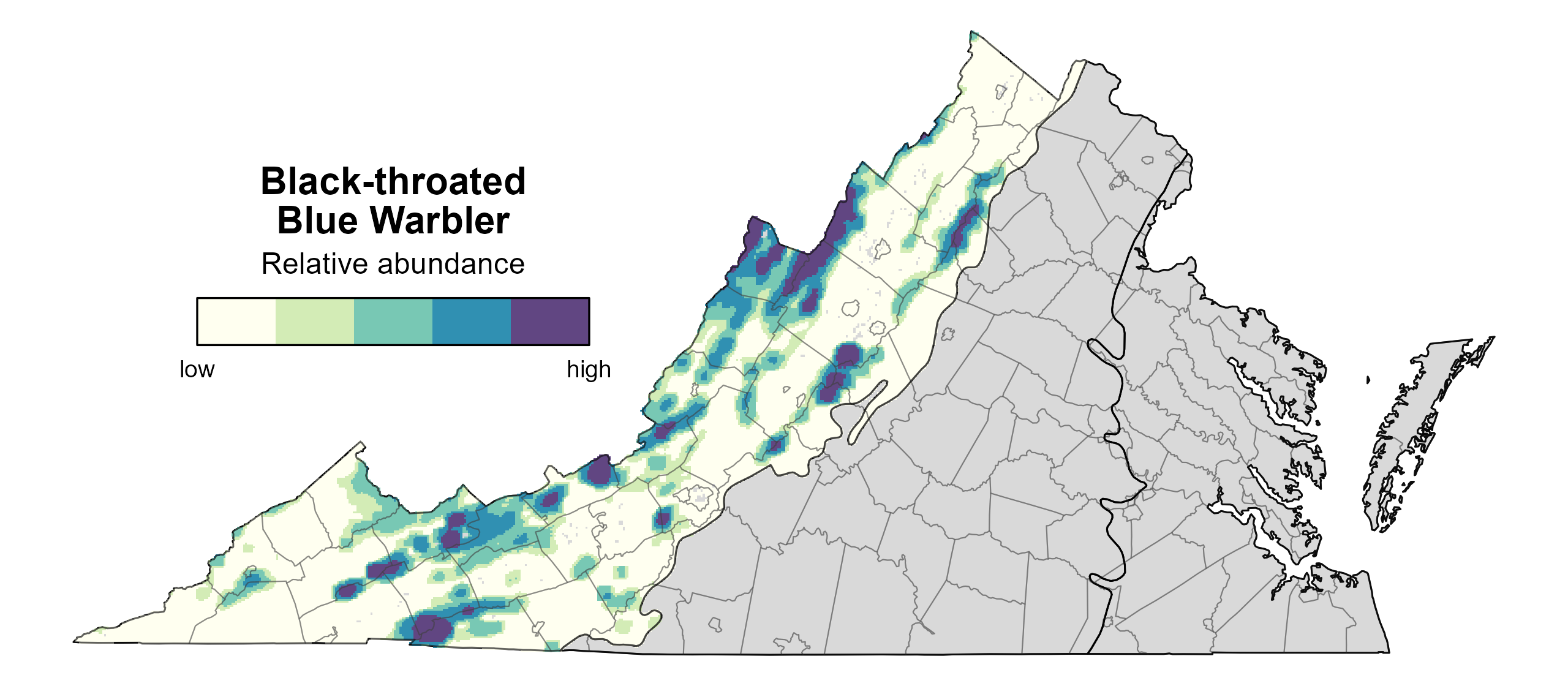
Figure 6: Black-throated Blue Warbler relative abundance. This map indicates the predicted abundance of this species at a 0.4 mi2 (1 km2) scale based on environmental (including habitat) factors. Abundance values are presented on a relative scale of low to high. Areas in gray are outside the species’ core range and were not modeled.
The accompanying narrative provides interpretation of the maps. Habitat relationships that affect occupancy largely influence abundance estimates as well, but there are some differences between them. This is a result of the spatial scale of the data used (block-level for occupancy, point for abundance) and of the modeling itself (block-level for occupancy, 0.4 mi2 [1 km2] for abundance). Given these discrepancies, in the narrative, we do not discuss the relationship of abundance with habitat variables derived from model results.
Population Trends
The population trends presented are not derived from Atlas data. The trends were generated from other data sources:
- Primarily, the North American Breeding Bird Survey (BBS) for 1966–2022 (Hostetler et al. 2023),
- Virginia Colonial Waterbird survey (conducted every five years in coastal Virginia),
- Virginia waterfowl surveys conducted as part of the Atlantic Flyway Breeding Waterfowl Survey,
- Virginia upland game bird surveys, Virginia Shorebird surveys (plovers and American Oystercatcher), and
- Virginia-based surveys for individual species (Peregrine Falcon and Red-cockaded Woodpecker).
Population trends are available for 170 of the 203 species. The majority of these are BBS trends, which are reported for 133 species. Regional BBS trends are reported when the Virginia trend was not considered credible based on data-related issues. Geography used include:
- Virginia BBS trend,
- the Eastern BBS region,
- the Atlantic Flyway region, and
- the four Bird Conservation Regions (BCRs) within which Virginia falls: Southeast Coastal Plain, New England/Mid-Atlantic Coastal Plain, Piedmont, and Appalachian Mountains.
Virginia BBS trends are shown for 81 species, and regional BBS trends are shown for 52 species. Regional trends were assigned based on a species’ distribution within the state.
It is important to note that although there are numerous sources that provide species population trends at state and regional scales, we selected the North American BBS data for consistency purposes, except for the sources noted above for specific suites of species.
Trends are reported in the narrative as the annual change in population size (e.g., five percent annual decrease) for the full BBS period noted above and for the period between the Atlases. For the latter estimate, the mid-points of the Atlas periods were used (from 1987 to 2018). Whether a trend is or is not statistically significant, i.e. due purely to chance (noted in the narrative as ‘significant’ and ‘nonsignificant’), is also noted.
BBS trend data are presented visually in a graph depicting the abundance index of a species (vertical axis) over time (years, on the horizontal axis) (an example is Figure 7). The abundance index is equivalent to the number of birds per BBS route and is based on modeling of BBS data; as such, it is not an absolute population value. The graph displays both the population trend (solid line) and the upper and lower values (dotted lines) within which there is 97.5% confidence that the true population trend line falls. The periods corresponding to the First Atlas (1985 to 1989) and Second Atlas (2016 to 2020) are highlighted by blue bars.

Figure 8: Black-throated Blue Warbler population trend for the Atlantic Flyway as estimated by the North American Breeding Bird Survey. The vertical axis shows species abundance; the horizontal axis shows the year. The solid line indicates the estimated population trend; there is a 97.5% probability that the true population trend falls between the dashed lines. The shaded bars indicate the First and Second Atlas periods.
Where possible, trend graphs based on non-BBS bird monitoring programs were also generated. These include graphs for multiple colonial waterbird species (gulls, terns, skimmers, herons, ibises, cormorants and pelicans) based on data from the 2023 Colonial Waterbird Surveys (Watts et al. 2024). These graphs show the number of breeding pairs from 1993, when the survey effort started, to 2023. The First and Second Atlas periods are represented by blue vertical bars. Graphs for select shorebird species (Wilson’s Plover, Piping Plover, and American Oystercatcher) cover different time periods but have a similar format.
Conservation
Species conservation status is reported relative to whether a species is listed as Threatened or Endangered at the state and/or federal level and to whether it is identified as a Species of Greatest Conservation Need (SGCN) in the 2025 Virginia Wildlife Action Plan.
For most SGCNs, this section summarizes information on threats and potential causes of the decline in the Virginia breeding population. It also highlights conservation actions and programs that are needed or that are already planned or taking place in Virginia.
The amount of relevant information differs among species, so these sections vary greatly in length. Substantially less content is included for species that are not SGCNs. However, this section may note potential threats to their populations if any have been identified, as well as potential benefits to their populations from existing conservation programs or actions targeted at species of higher conservation priority.
Interactive Map
Each interactive map contains up to six Atlas layers (probability of occurrence for the First and Second Atlases, change in probability of occurrence between Atlases, breeding evidence for the First and Second Atlases, and abundance for the Second Atlas) that can be viewed one at a time. To view an Atlas map layer, mouse over the layer box in the upper left.
The base map is ESRI, and county lines and physiographic regional boundaries (Mountains and Valleys, Piedmont, and Coastal Plain) can be turned on and off by checking or unchecking the box below the layer box. Within the map window, users can hover on a block to see its value for each layer and pan and zoom to see roads, towns, and other features of interest that are visible beneath a selected layer.
Additionally, there is a link below the map that will open the interactive map in full screen mode in a new window.
References
All references cited within the text for each Species Account are included in this section.
Literature Cited in this “Interpreting the Species Accounts”
Chesser, R. T., S. M. Billerman, K. J. Burns, C. Cicero, J. L. Dunn, B. E. Hernández-Baños, R. A. Jiménez, O. Johnson, N. A. Mason, and P. C. Rasmussen (2025). Check-list of North American Birds (online). American Ornithological Society. https://doi.org/10.1093/ornithology/ukaf015.
Hostetler, J. A., J. R. Sauer, J. E. Hines, D. Ziolkowski, and M. Lutmerding (2023). The North American breeding bird survey, analysis results 1966–2022. U.S. Geological Survey, Laurel, MD, USA. https://doi.org/10.5066/P9SC7T11.
Watts, B. D., B. J. Paxton, R. Boettcher, and A. L. Wilke (2024). Status and distribution of colonial waterbirds in coastal Virginia: 2023 breeding season. Center for Conservation Biology Technical Report Series, CCBTR-24-12. William & Mary, Williamsburg, VA, USA. 27 pp.