Introduction
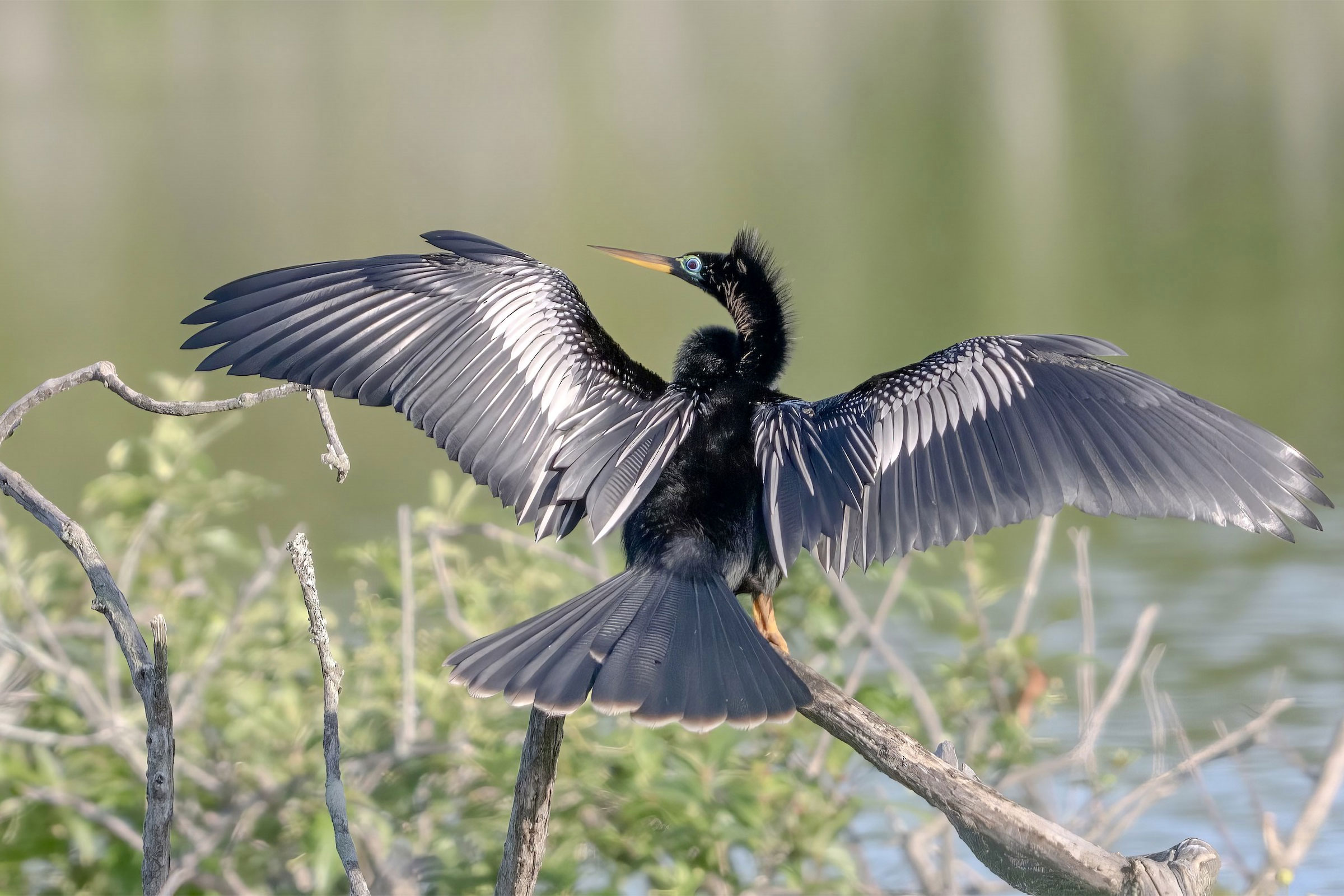
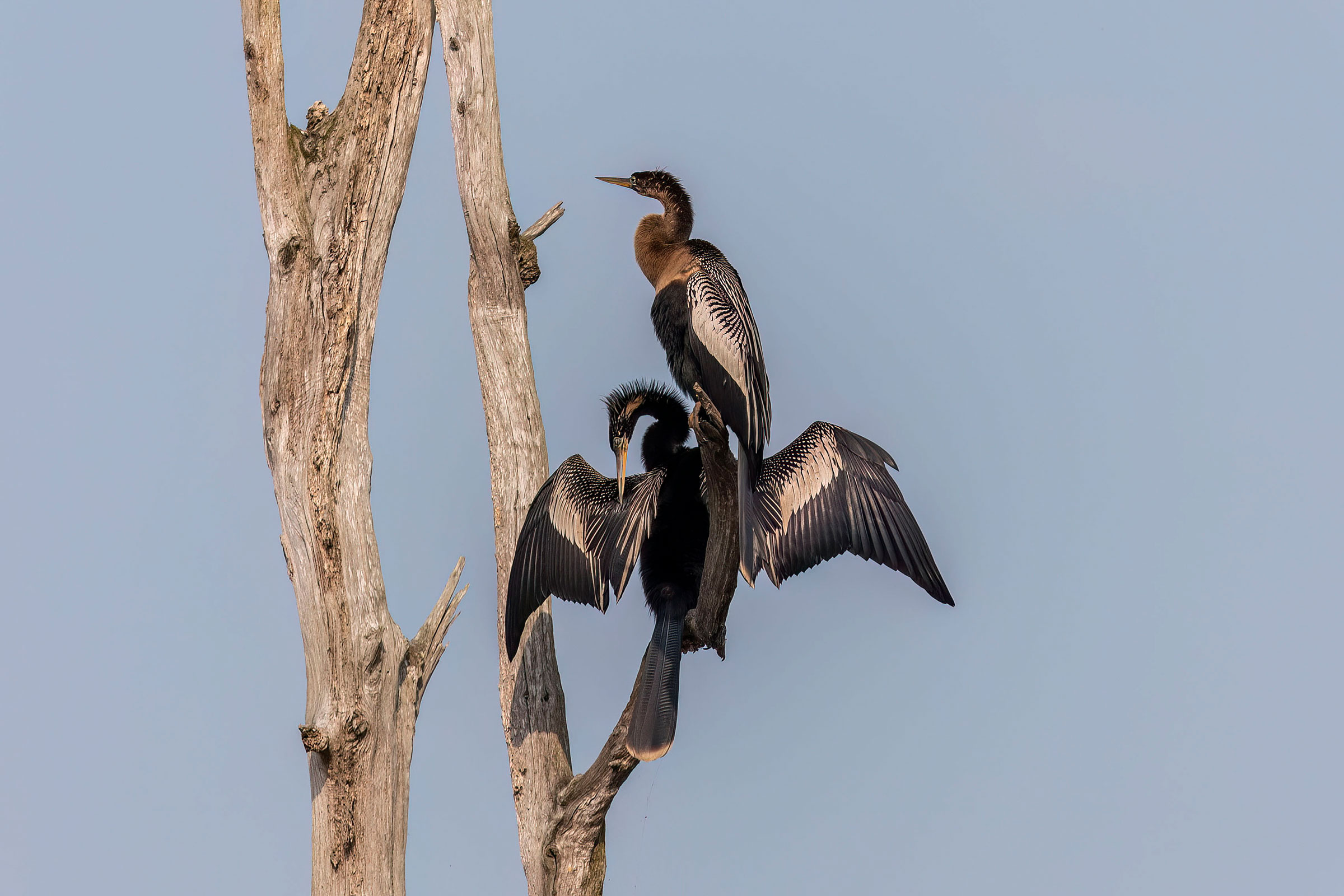
A new addition to Virginia’s breeding avifauna since the First Atlas, Anhinga is an odd bird. This pin-headed relative of cormorants is also known as “water turkey” and “snake bird” for its anatomy and as “devil bird” as a translation of its common and scientific name, which originates from the Tupi people of Brazil (Choate 1985). Around the world, its closest relatives are typically called “darters” for their underwater dives. Like cormorants, Anhingas spend extensive time drying their wet feathers after swimming. They breed colonially, often with other species such as herons, egrets, and cormorants (Frederick and Siegel-Causey 2020).
Breeding Distribution
Formerly rare summer visitors (Rottenborn and Brinkley 2007), usually in southeastern Virginia near the North Carolina border, Anhingas now breed regularly in Virginia. They are still relatively uncommon breeders, however, and observations of the species were too few to support development of a distribution model. The species nests in swamps or other freshwater areas with slow-moving waters and trees or shrubs (Frederick and Siegel-Causey 2020). For information on where the species occurs in Virginia, please see the Breeding Evidence section.
Breeding Evidence
A species of the Atlantic and Gulf Coasts, Anhingas have historically bred south of Virginia, reaching their northern limit in North Carolina. Summer records for Virginia date back to 1936 (Murray, 1938), and the species occurs most regularly south of the James River, particularly at Stumpy Lake Natural Area (Virginia Beach) (Rottenborn and Brinkley 2007). It was at that site that breeding activity was observed as early as 1981, though breeding could not be conclusively confirmed (Rottenborn and Brinkley 2007). Anhingas were not reported during the First Atlas, and the first documented breeding confirmation for Virginia was in 2009 at Harwood Mills Reservoir (VSO 2009).
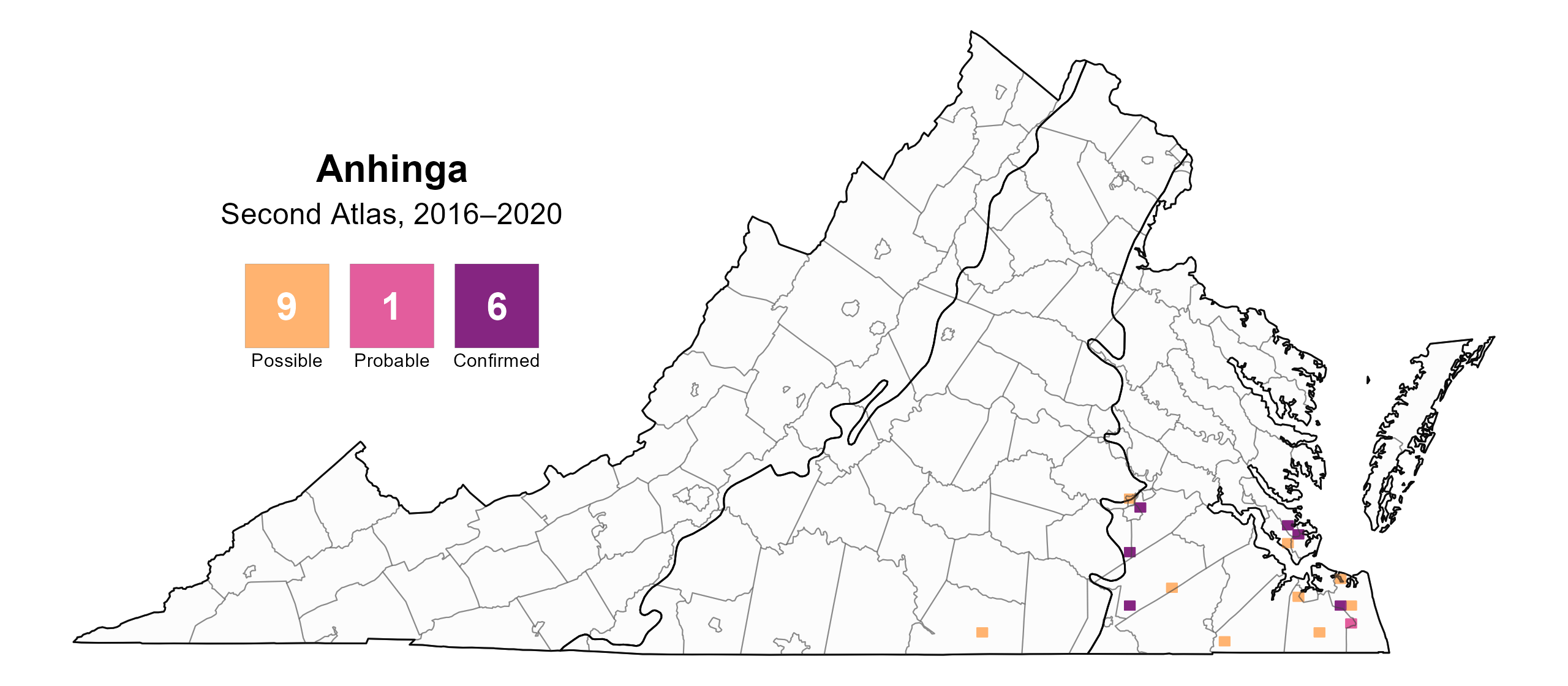
During the Second Atlas, Anhingas were confirmed breeders in six blocks in four counties (Figure 1). Confirmations were recorded in Stumpy Lake Natural Area (Virginia Beach), Big Bethel Reservoir and Harwoods Mill Reservoir (York County), Harrell Road (Sussex County), and the Blackwater Swamp on Fort Gregg-Adams and Carson Wetlands (Prince George County). At Fort Gregg-Adams, Anhingas were first documented as breeders in 2018, and monitoring efforts documented as many as four nesting pairs during the Atlas period (Dana Bradshaw, personal communication). Probable breeders were observed at a pond along Blackwater Road (Chesapeake). Possible breeders were documented in appropriate habitat in several other locations, most notably in a swamp along Kettles Creek (Mecklenburg County), the only Atlas record firmly in the Piedmont region.
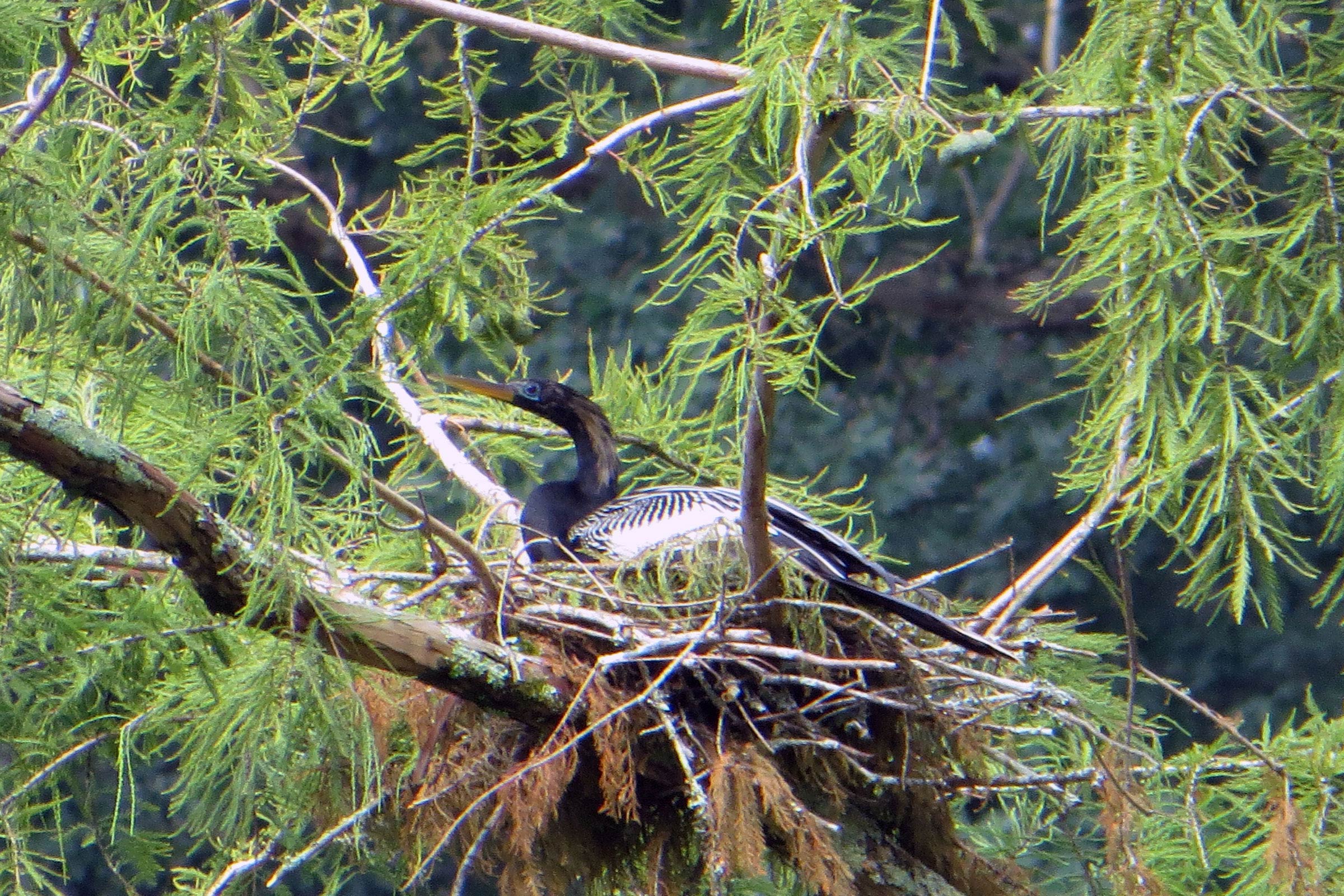
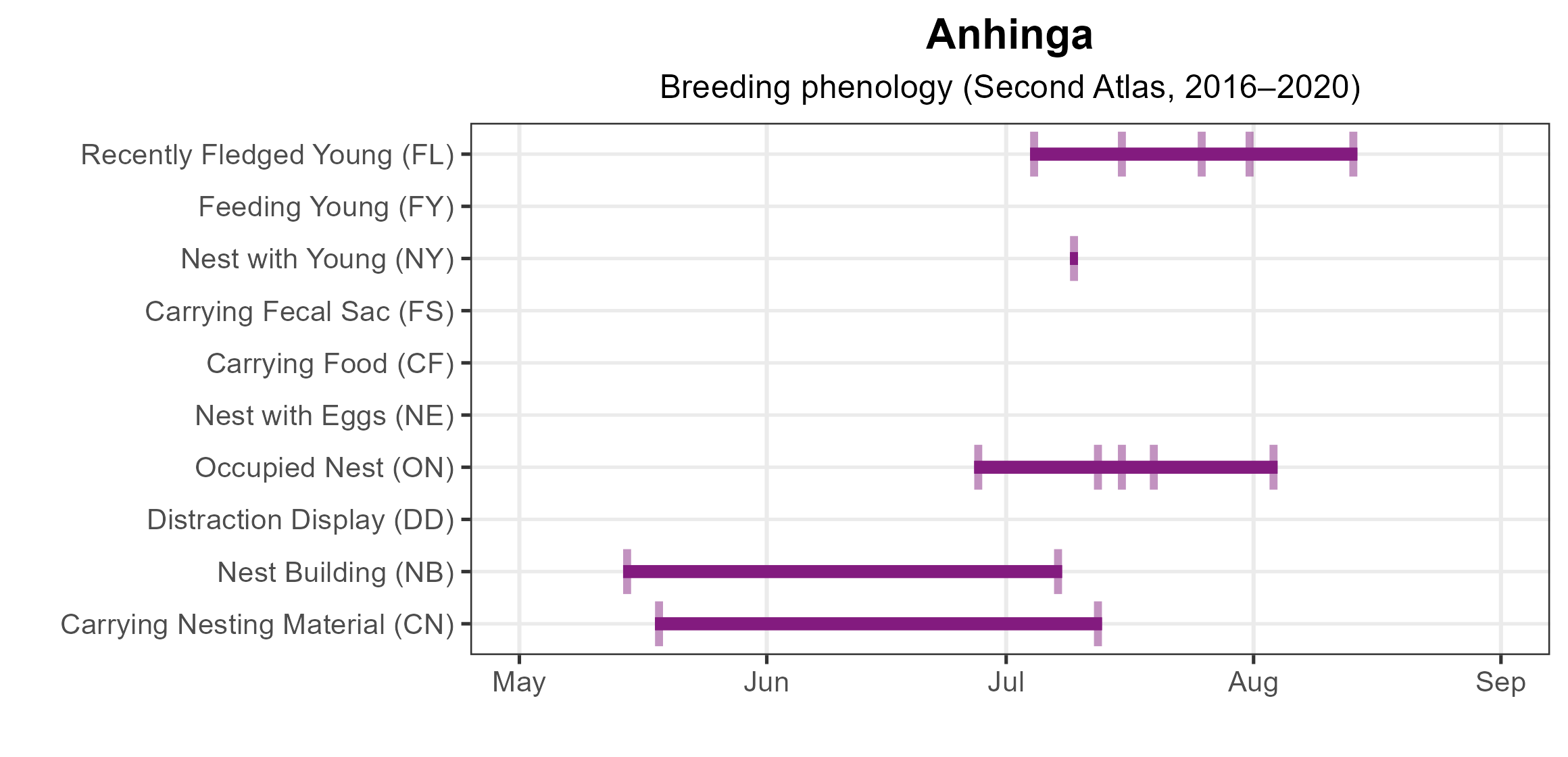
Anhingas were observed carrying nesting material and building nests between May 14 and July 12; this included observations of adults breaking branches from trees (Figure 2). Volunteers reported one to three nests per location, as well as congregations of adults numbering as many as 11 at the Harwoods Mill Reservoir site in York County. Nests were reported in cypress (Cupressus sp.) and loblolly pine (Pinus taeda), with some nests in the same tree as nesting Great Blue Herons (Ardea herodias) and Great Egrets (Ardea alba). Occupied nests were observed between June 27 and August 3, but only one observation was made of young in the nest on July 9. Fledgling Anhingas were seen between July 4 and August 13. For more general information on the breeding habits of the Anhinga, please refer to All About Birds.
Population Status
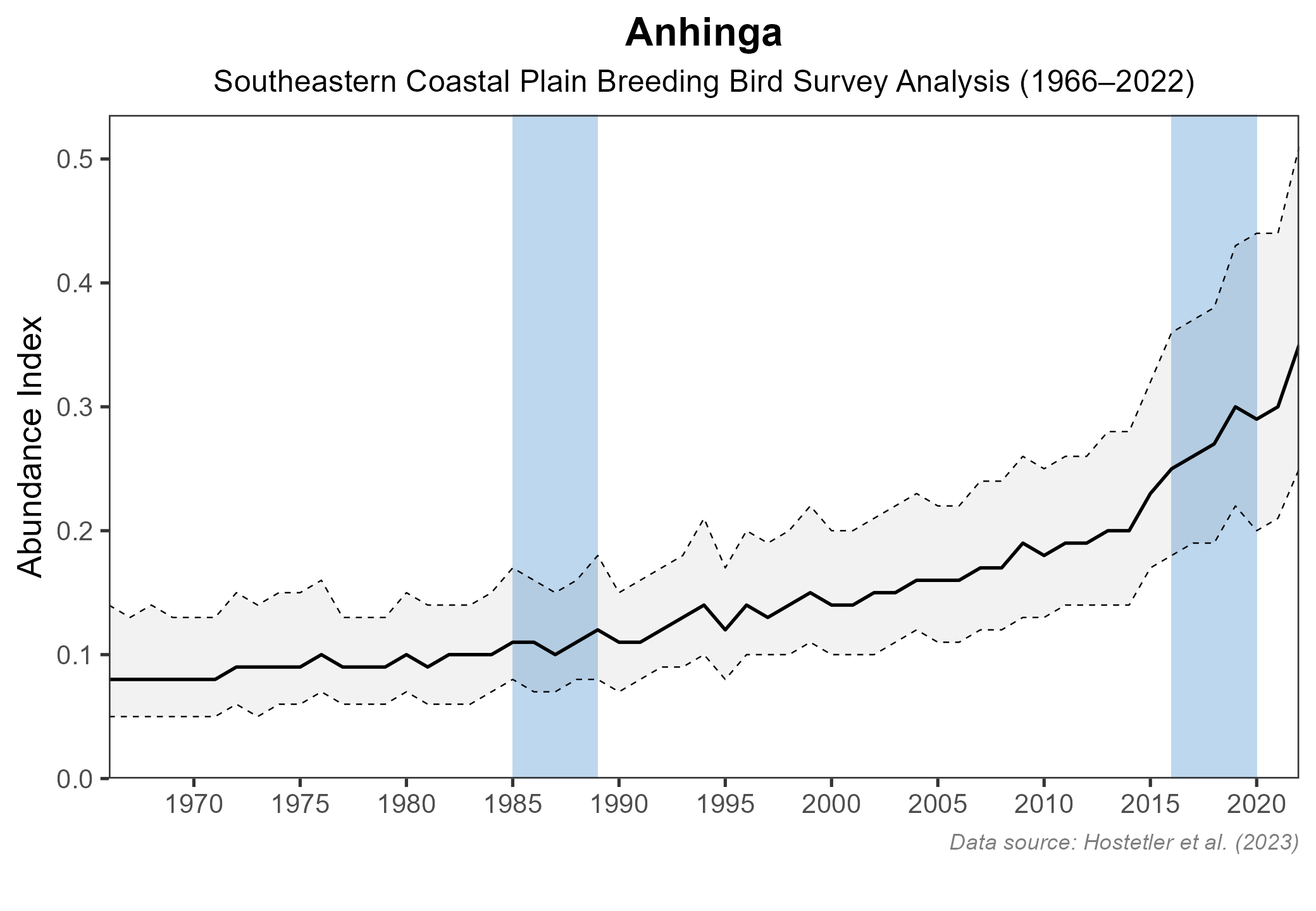
Abundance could not be modeled because Anhingas were only documented as flyovers during the Atlas point count surveys. Anhingas are not regularly detected by the North American Breeding Bird Survey (BBS) in Virginia. However, in the core of their range in the southeastern Coastal Plain, Anhingas have experienced a significant increase of 2.6% per year from 1966–2022 (Hostetler et al. 2023; Figure 3). This population growth has likely contributed to their northward expansion. The trend was similar between the First and Second Atlas, with a significant increase of 3.15% per year from 1987–2018.
Conservation
A relatively new but now established breeder in Virginia, the Anhinga continues to expand its range within the Commonwealth, with a surge in the number of records since 2010 (Bryan Watts, personal communication). As their Virginia population continues to increase, they will likely continue to spread along waterways to new freshwater sites, particularly those already occupied by colonial waterbirds. Thus, they will benefit from actions that protect these colonies.
Interactive Map
The interactive map contains up to six Atlas layers (probability of occurrence for the First and Second Atlases, change in probability of occurrence between Atlases, breeding evidence for the First and Second Atlases, and abundance for the Second Atlas) that can be viewed one at a time. To view an Atlas map layer, mouse over the layer box in the upper left. County lines and physiographic regional boundaries (Mountains and Valleys, Piedmont, and Coastal Plain) can be turned on and off by checking or unchecking the box below the layer box. Within the map window, users can hover on a block to see its value for each layer and pan and zoom to see roads, towns, and other features of interest that are visible beneath a selected layer.
View Interactive Map in Full Screen
References
Choate, E. A. (1985). The dictionary of American bird names. (R. A. Paynter Jr., Editor). The Harvard Common Press, Boston, MA, USA.
Frederick, P. C., and D. Siegel-Causey (2020). Anhinga (Anhinga anhinga), version 1.0. In Birds of the World (A. F. Poole and F. B. Gill, Editors). Cornell Lab of Ornithology, Ithaca, NY, USA. https://doi.org/10.2173/bow.anhing.01.
Hostetler, J. A., J. R. Sauer, J. E. Hines, D. Ziolkowski, and M. Lutmerding (2023). The North American breeding bird survey, analysis results 1966–2022. U.S. Geological Survey, Laurel, MD, USA. https://doi.org/10.5066/P9SC7T11.
Murray, J.J. (1938). Recent records and new problems in Virginia ornithology. The Raven 9:39–43.
Rottenborn, S. C., and E. S. Brinkley (Editors) (2007). Virginia’s birdlife: an annotated checklist. 4th edition. Virginia Society of Ornithology.
Virginia Society of Ornithology (VSO) (2009). Summer records June – July 2009. Virginia Birds 6:1–12.