There are many actions you can take now that will have positive impacts across many different species of birds:
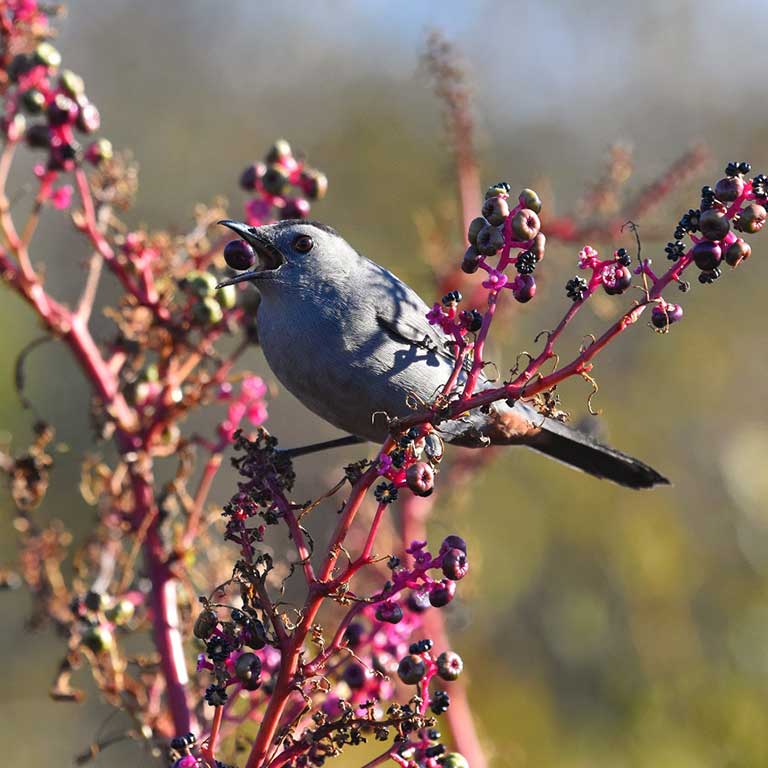
A Gray Catbird feasts on the berries of pokeweed (Phytolacca americana). This and other native plants maturing during the late summer and fall can be an important source of food for migrating birds. © Betty Sue Cohen
- Advocate for conservation and restoration of ecologically important lands. Explore ecological values of lands near you using the Virginia Department of Conservation and Recreation’s Natural Heritage Data Explorer.
- Advocate for local land use and development officials to consider tree preservation, habitat corridor preservation (or creation), and redirection of development away from ecologically sensitive areas. The best source of information for proposals near you is your local planning office.
- Use native landscaping in your yard as an alternative to bird feeders. Learn more through the Virginia Native Plant Society and the Virginia Department of Wildlife Resource’s Habitat at Home program. Additional resources are available through the Northern Virginia Bird Alliance and the Loudoun Wildlife Conservancy.
- If you do feed birds, make sure you do it safely and responsibly to minimize the spread of feeder-related diseases. See the Virginia Department of Wildlife Resources Guide to Safe Bird Feeding to learn more about cleaning guidelines and recommended feed types.
- Limit the use of herbicides, pesticides, and other toxic chemicals. See more information from the American Bird Conservancy.
- Advocate for and support policies that mitigate climate change. Read up on the American Bird Conservancy website.
- Turn off unnecessary outdoor lighting. Learn more about the National Audubon Society’s Lights Out Program, which explains how nighttime lighting can disorient birds and lead to collisions with glass on buildings.
- Keep cats indoors! They are a leading cause of bird mortality. Read more about cats on the American Bird Conservancy website.
- Consider buying shade-grown coffee in lieu of conventional coffee where the coffee farming practices may be damaging winter habitat for neotropical migrants. See further information from the Smithsonian Institution.
- If you are a hunter or angler, do your part to reduce ingestion of toxic lead by wildlife. You can choose lead-free ammunition and tackle or take voluntary actions such as retrieving spent materials and harvesting animals in their entirety from the field. Read more on the U.S. Fish and Wildlife Service website.
- Reduce energy and water use. See articles from the Cornell Laboratory of Ornithology and World Migratory Bird Day.
- Recycle and use recycled products. See more on the Environmental Protection Agency’s Reduce, Reuse, Recycle page.
- Add decals or other deterrents to glass windows to help prevent bird collisions. See the American Bird Conservancy’s reviews of different options.
- Participate in citizen science projects like the North American Breeding Bird Survey, Audubon Christmas Bird Count, and eBird’s Global Big Day to help deepen our understanding of birds in our environment.
- Join your local bird club or Audubon chapter! Virginia’s clubs are listed on the Virginia Society of Ornithology website.
- Become a Virginia Master Naturalist and participate in community projects that support habitat conservation and your local bird populations.
- Go birding and report your sightings in eBird! eBird is more than just a way to track your bird observations. eBird data are regularly used in research, developing conservation initiatives, and informing policy and laws.
- Donate to the Virginia Department of Wildlife Resources Nongame fund by sending a check, made payable to the Treasurer of Virginia, addressed to Virginia Department of Wildlife Resources, c/o Amy Martin, Virginia’s Nongame Program, P.O. Box 90778, Henrico, VA 23228-0778.