Introduction
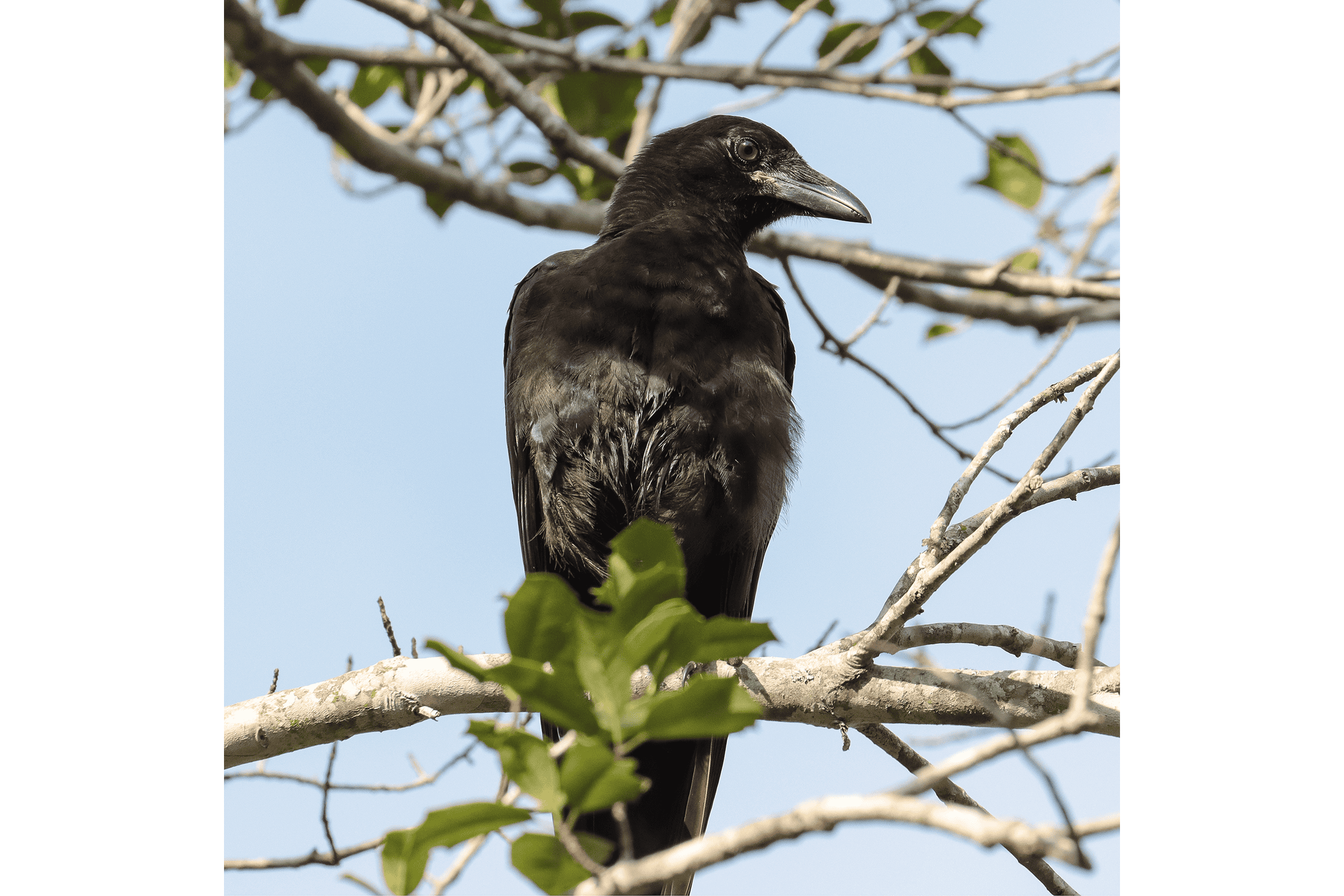
The American Crow is a clever opportunist, adaptable in terms of habitat and behavior. In the 20th century, the species began to exploit the concentrated resources present in cities (Verbeek and Caffrey 2021), leading to its familiar habits as a garbage pilferer. Throughout much of Virginia, both American Crows and Fish Crows (Corvus ossifragus) are present, and voice is the easiest way to distinguish them, with the American Crow making a clearer, less nasal kraw kraw!
In addition to joining massive roosting flocks, American Crows stay in family groups for up to four or five years, helping their parents raise their siblings until they are ready to breed on their own (Verbeek and Caffrey 2021). In Virginia, American Crows are often observed nesting in coniferous trees such as pines (Pinus spp.), eastern red cedar (Juniperus virginiana), and arborvitae (Thuja spp.) (Clapp and Banks 1993).
Breeding Distribution
American Crows are present year-round in Virginia and occur in all regions of the state (Figure 1). The likelihood of American Crow occurrence in a block is slightly positively associated with surrounding forest cover. However, these effects were small given the likelihood of American Crow occurrence is over 65% even at its lowest and is greater than 95% over nearly the entirety of Virginia.
American Crow’s distribution during the First Atlas and its change between the two Atlas periods could not be modeled due to data and model limitations (see Interpreting Species Accounts). For more information on its distribution during the First Atlas, please see the Breeding Evidence section.
View Environmental Associations
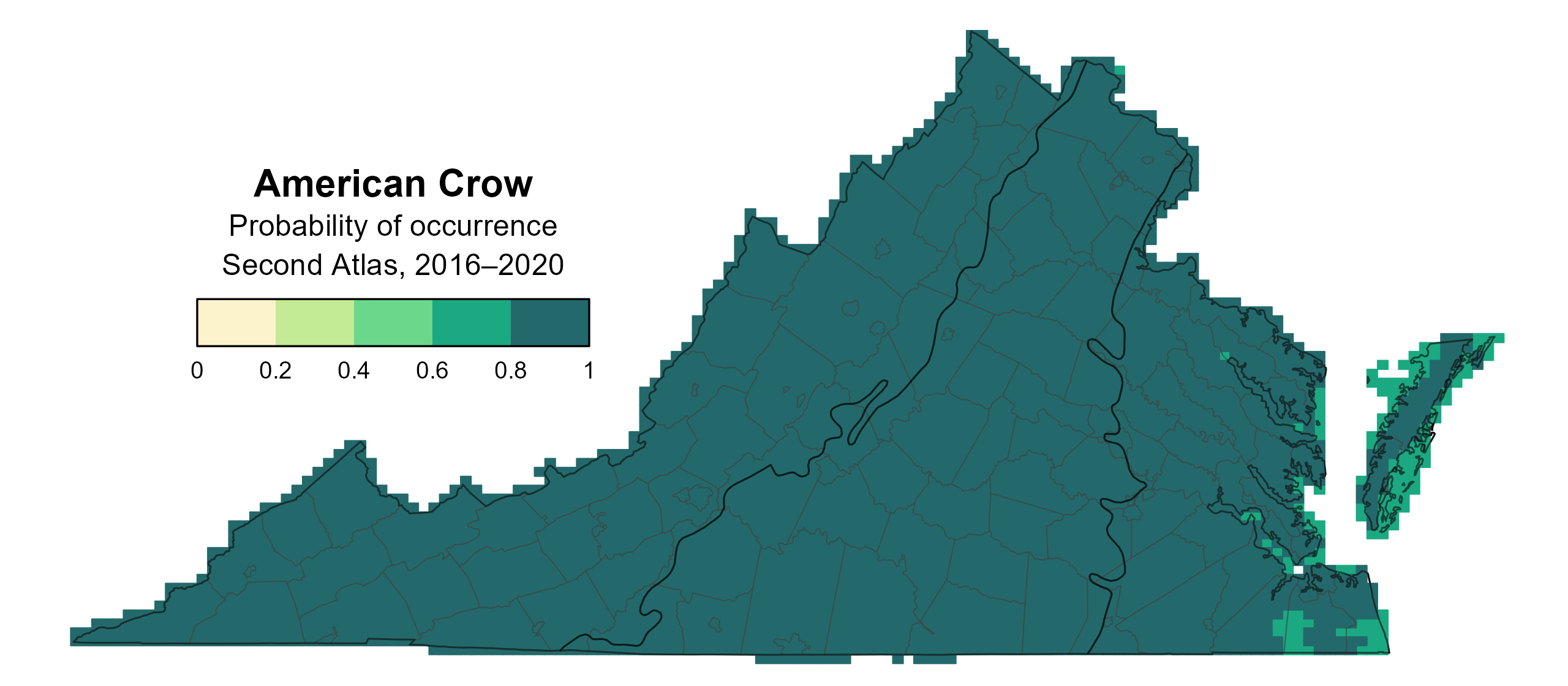
Figure 1: American Crow breeding distribution based on probability of occurrence (Second Atlas, 2016–2020). This map indicates the probability that this species will occur in an Atlas block (an approximately 10 mi2 [26 km2] survey unit) based on environmental (including habitat) factors and after adjusting for the probability of detection (variation in survey effort among blocks).
Breeding Evidence
American Crows were confirmed breeders in 816 blocks and 114 counties and probable breeders in an additional four counties (Figure 2). Breeding confirmations were also recorded throughout the state during the First Atlas (Figure 3).
American Crows began collecting nesting material on February 21 and building nests February 26. Other breeding confirmations were recorded from March 17 (occupied nest) through August 27 (recently fledged young). No nests with eggs were observed during the Second Atlas (Figure 4). For more general information on the breeding habits of the American Crow, please refer to All About Birds.

Figure 2: American Crow breeding observations from the Second Atlas (2016–2020). The colored boxes illustrate Atlas blocks (approximately 10 mi2 [26 km2] survey units) where the species was detected. The colors show the highest breeding category recorded in a block. The numbers within the colors in the legend correspond to the number of blocks with that breeding evidence category.

Figure 3: American Crow breeding observations from the First Atlas (1985–1989). The colored boxes illustrate Atlas blocks (approximately 10 mi2 [26 km2] survey units) where the species was detected. The colors show the highest breeding category recorded in a block. The numbers within the colors in the legend correspond to the number of blocks with that breeding evidence category.
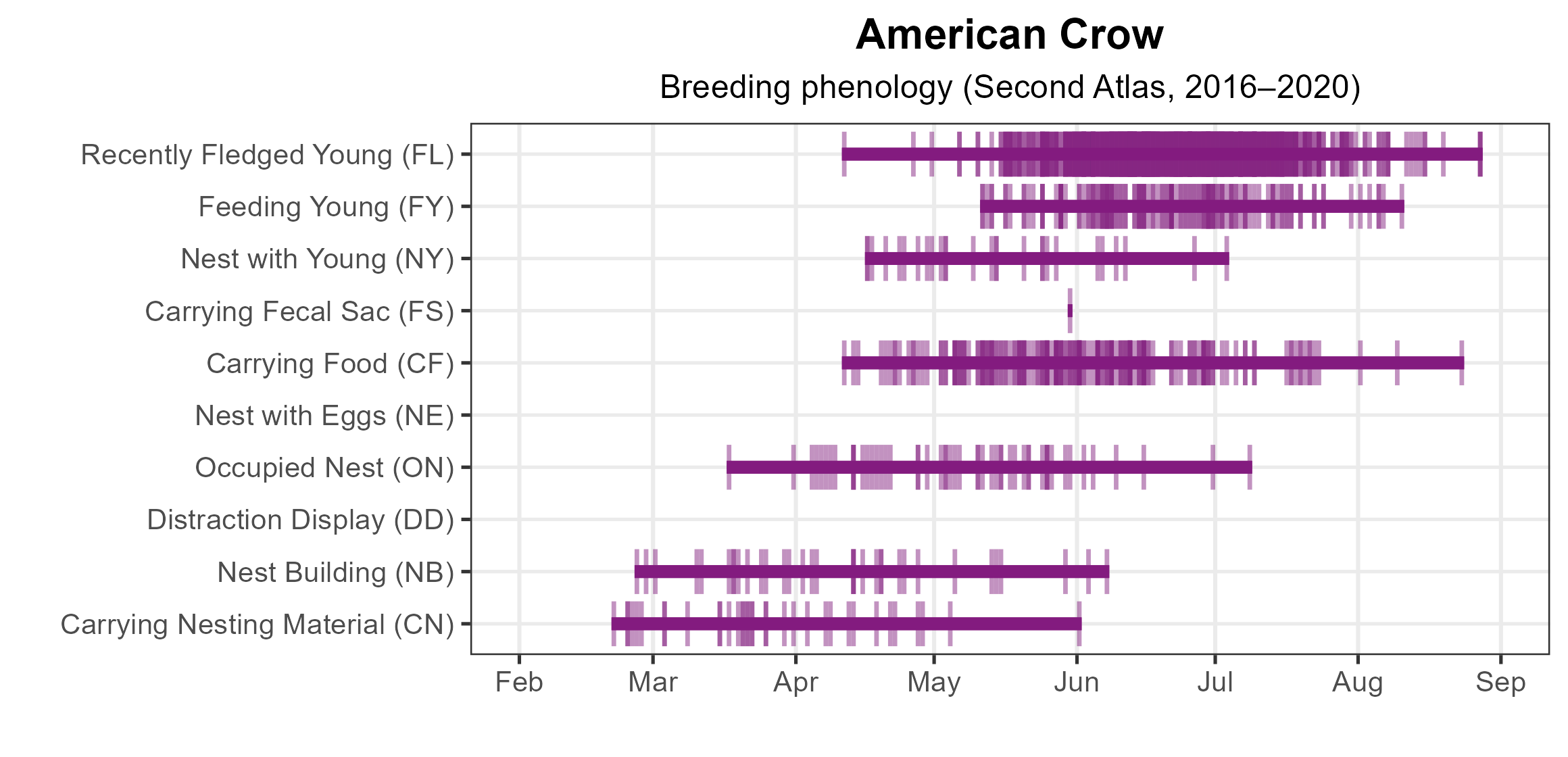
Figure 4: American Crow phenology: confirmed breeding codes. This graph shows a timeline of confirmed breeding behaviors. Tick marks represent individual observations of the behavior.
Population Status
American Crow relative abundance was estimated to be moderate throughout Virginia, especially in areas with development and agricultural lands as well as shrublands and grasslands (Figure 5). They reached their highest levels in Northern Virginia, particularly in Fairfax and Arlington Counties, as well as around Richmond and parts of the Hampton-Roads area. Abundance was predicted to be lower in the coastal habitats of the Eastern Shore and at high elevations in the Blue Ridge Mountains, Allegheny, and Cumberland Mountains.
The total estimated American Crow population in the state is approximately 1,022,000 individuals (with a range between 674,000 and 1,556,000). Based on North American Breeding Bird Survey (BBS) data, its population showed a nonsignificant decrease of 0.1% per year from 1966–2022 in Virginia (Hostetler et al. 2023; Figure 6). Between the First and Second Atlas, its population experienced a significant decline of 0.66% per year from 1987–2018.
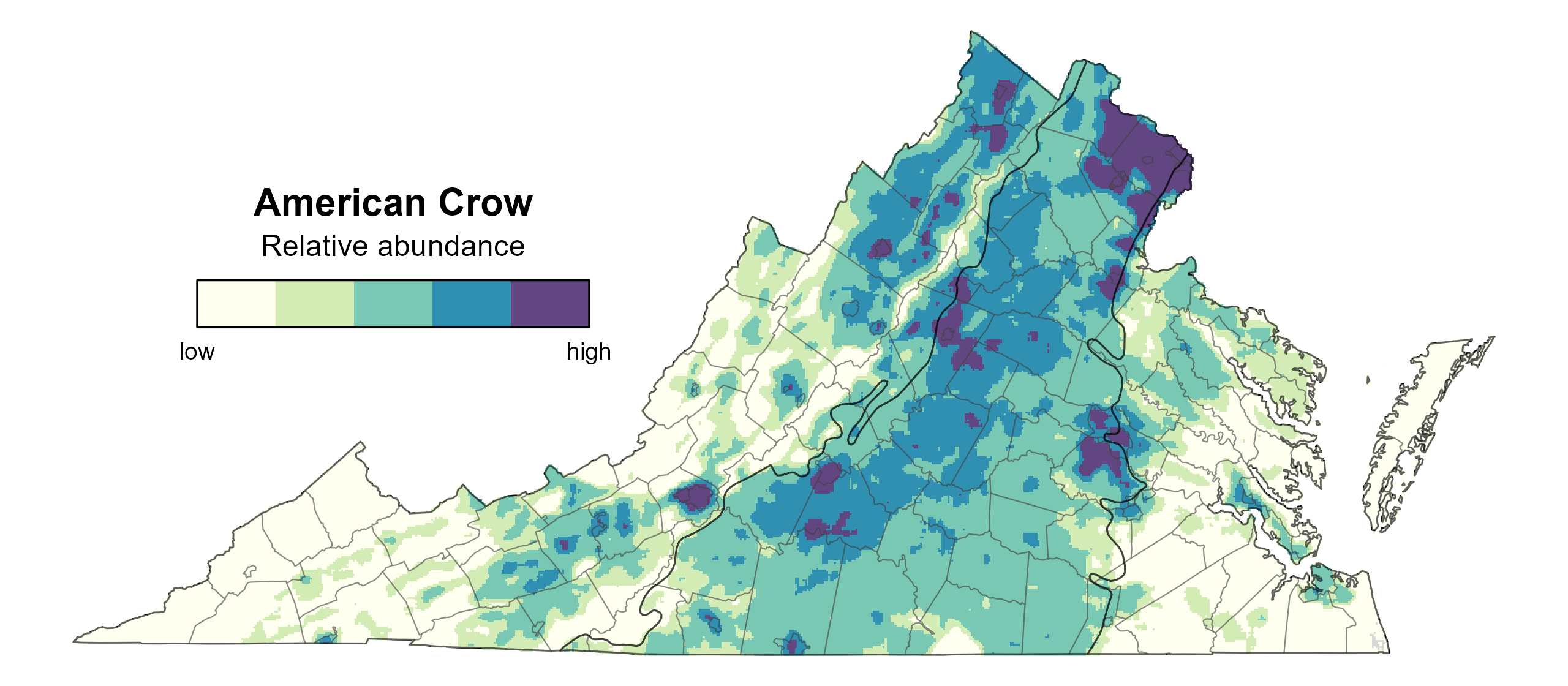
Figure 5: American Crow relative abundance (Second Atlas, 2016–2020). This map indicates the predicted abundance of this species at a 0.4 mi2 (1 km2) scale based on environmental (including habitat) factors. Abundance values are presented on a relative scale of low to high.
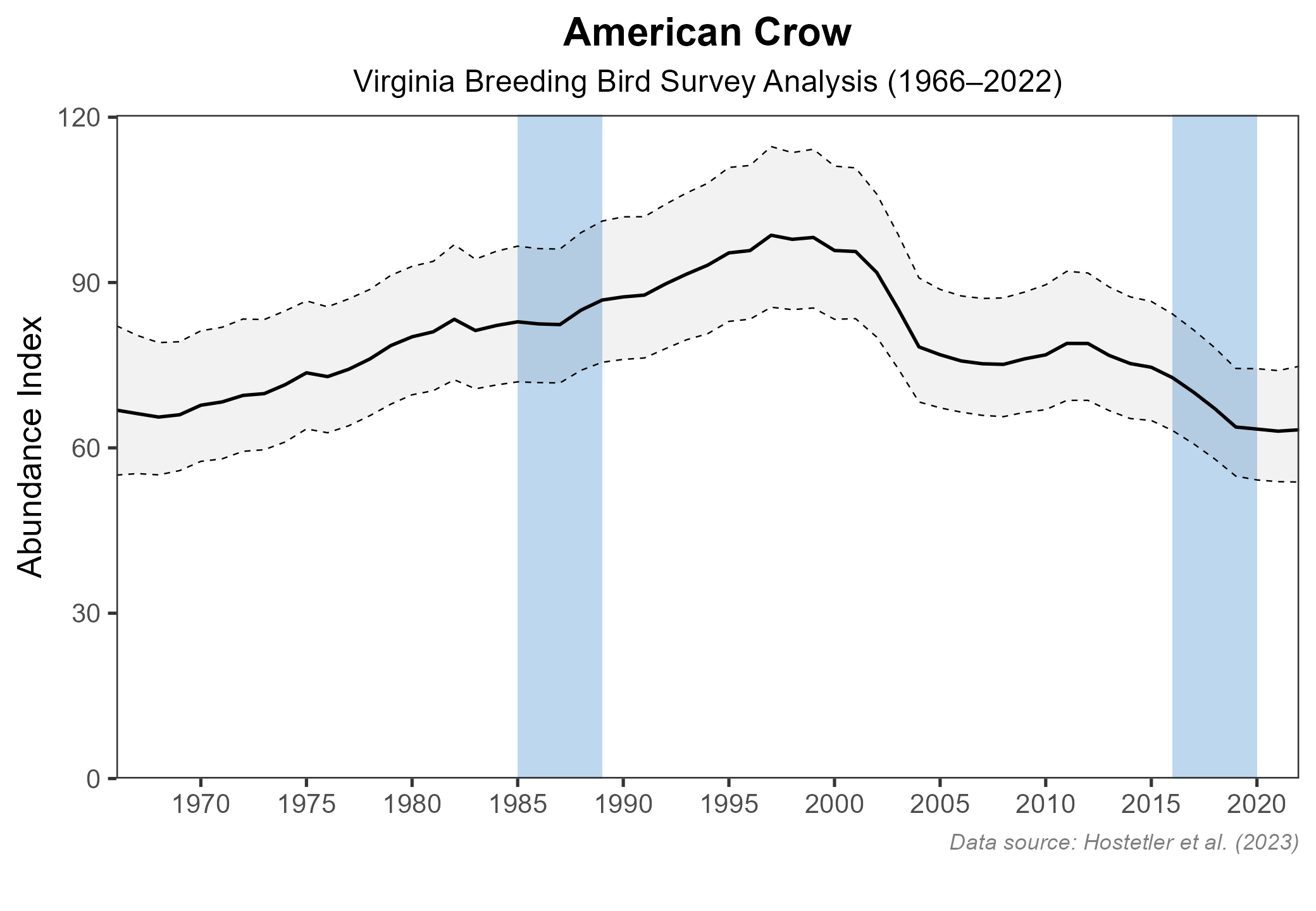
Figure 6: American Crow population trend for Virginia as estimated by the North American Breeding Bird Survey. The vertical axis shows species abundance; the horizontal axis shows the year. The solid line indicates the estimated population trend; there is a 97.5% probability that the true population trend falls between the dashed lines. The shaded bars indicate the First and Second Atlas periods.
Conservation
American Crow populations appear secure in the state, and the species is not the focus of any specific conservation efforts in the state. This species is legally hunted in Virginia. There is a small game season for American and Fish Crows, and they are the only migratory game birds that do not require a special permit (VDWR, n.d.). While they are not a species of conservation concern, American Crows are often the targets of human interactions in urban and agricultural environments alike (Verbeek and Caffrey 2021). Additionally, outbreaks of West Nile Virus have been observed in American Crows nationally (Caffrey et al. 2005; Foppa et al. 2011), and coincident outbreaks with humans and crows have been studied in Virginia (Liu et al. 2011).
Interactive Map
The interactive map contains up to six Atlas layers (probability of occurrence for the First and Second Atlases, change in probability of occurrence between Atlases, breeding evidence for the First and Second Atlases, and abundance for the Second Atlas) that can be viewed one at a time. To view an Atlas map layer, mouse over the layer box in the upper left. County lines and physiographic regional boundaries (Mountains and Valleys, Piedmont, and Coastal Plain) can be turned on and off by checking or unchecking the box below the layer box. Within the map window, users can hover on a block to see its value for each layer and pan and zoom to see roads, towns, and other features of interest that are visible beneath a selected layer.
View Interactive Map in Full Screen
References
Caffrey, C., S. C. R. Smith, and T. J. Weston (2005). West Nile Virus devastates an American Crow population. The Condor 107:128–32. https://doi.org/10.1093/condor/107.1.128.
Clapp, R. B., and R. C. Banks (1993). Nesting seasons, nest sites, and clutch sizes of crows in Virginia.” The Raven 62:90–89.
Foppa, I. M., R. H. Beard, and I. H. Mendenhall (2011). The impact of West Nile Virus on the abundance of selected North American birds. BMC Veterinary Research 7:43. https://doi.org/10.1186/1746-6148-7-43.
Fujisaki, I., E. V. Pearlstine, and M. Miller (2008). Detecting population decline of birds using long-term monitoring data. Population Ecology 50:275–84. https://doi.org/10.1007/s10144-008-0083-7.
Hostetler, J. A., J. R. Sauer, J. E. Hines, D. Ziolkowski, and M. Lutmerding (2023). The North American breeding bird survey, analysis results 1966–2022. U.S. Geological Survey, Laurel, MD, USA. https://doi.org/10.5066/P9SC7T11.
Liu, H., Q. Weng, and D. Gaines (2011). Geographic incidence of human West Nile virus in northern Virginia, USA, in relation to incidence in birds and variations in urban environment. Science of the Total Environment 409:4235-4241. https://doi.org/10.1016/j.scitotenv.2011.07.012.
Rottenborn, S. C., and E. S. Brinkley (Editors) (2007). Virginia’s birdlife: an annotated checklist. 4th edition. Virginia Society of Ornithology.
Verbeek, N. A., and C. Caffrey (2021). American Crow (Corvus brachyrhynchos), version 1.1. In Birds of the World (A. F. Poole and F.B. Gill, Editors). Cornell Lab of Ornithology, Ithaca, NY, USA. https://doi.org/10.2173/bow.amecro.01.2.
Virginia Department of Wildlife Resources (VDWR). n.d. Small game hunting regulations and seasons. https://dwr.virginia.gov/hunting/regulations/smallgame/. (Accessed March 25, 2024).