Introduction
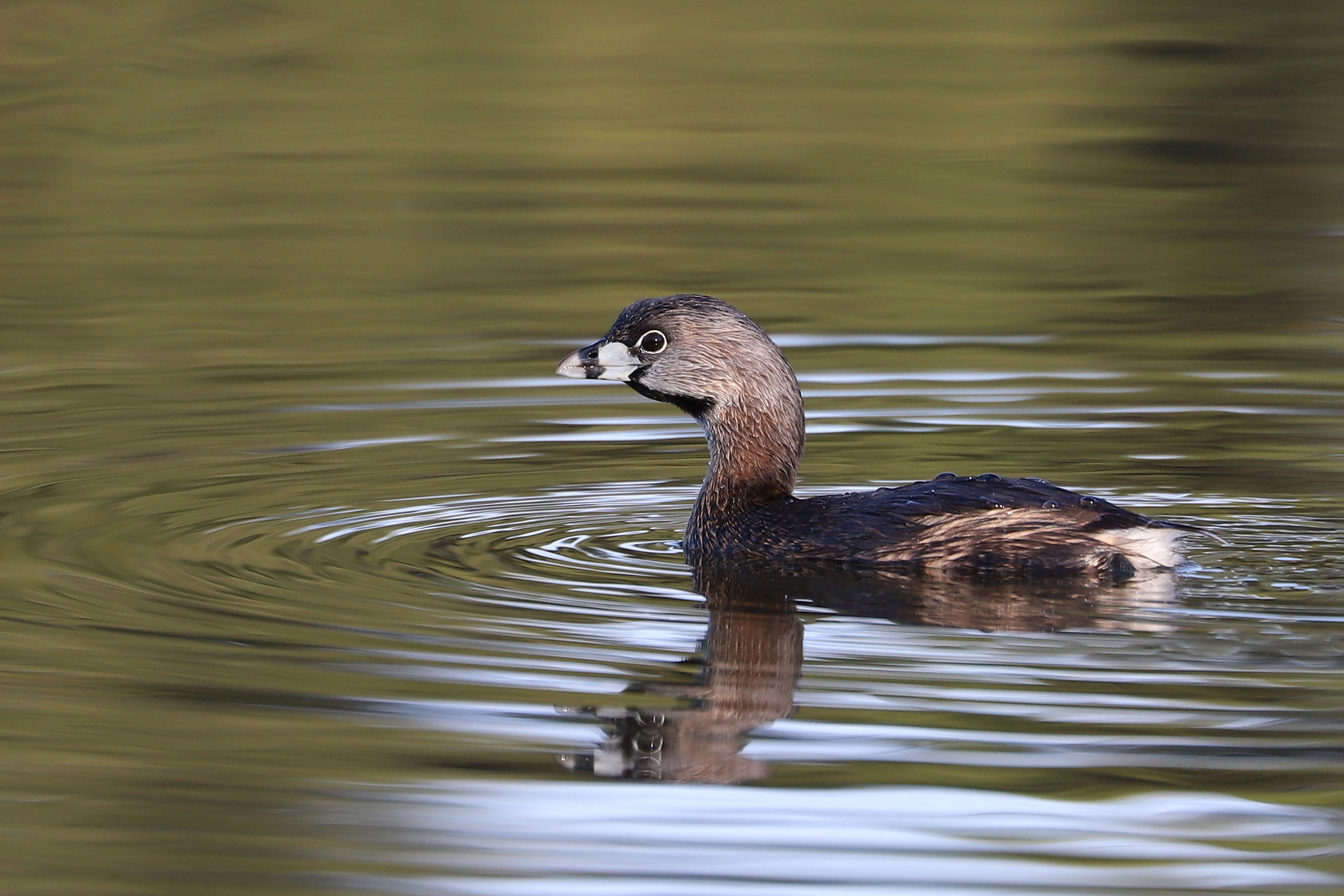
Named after the light-colored bill with a distinctive vertical black band that it sports only during the breeding season, the Pied-billed Grebe is completely at home in the water. In fact, as excellent and frequent divers, Pied-billed Grebes sometimes give the impression of spending more time under the water than above it. With legs positioned toward the back of the body for forward propulsion, they are adept at catching fast-moving crayfish and small fish (Muller and Storer 2020).
Pied-billed Grebes are associated with both freshwater and brackish marshes within the Chesapeake Bay region (Wilson and Watts 2007), as well as with dense stands of vegetation on the edges of ponds. They build a floating nest platform in marshes, ponds, and bays and sloughs of slow-moving rivers (Muller and Storer 2020). Nests are usually situated in dense emergent vegetation where they are difficult to find. While Pied-billed Grebes are relatively common winter residents throughout much of Virginia, they are rare to the Commonwealth during the breeding season (Rottenborn and Brinkley 2007).
Breeding Distribution
The Chesapeake Bay is near the edge of the Pied-billed Grebe’s southeastern breeding range, and the species has never bred in abundance in Virginia (Wilson and Watts 2007). With just over a dozen reports of Pied-billed Grebe during the Second Atlas, there were too few observations to develop distribution models. Please see the Breeding Evidence section for more information on its breeding distribution.
Breeding Evidence
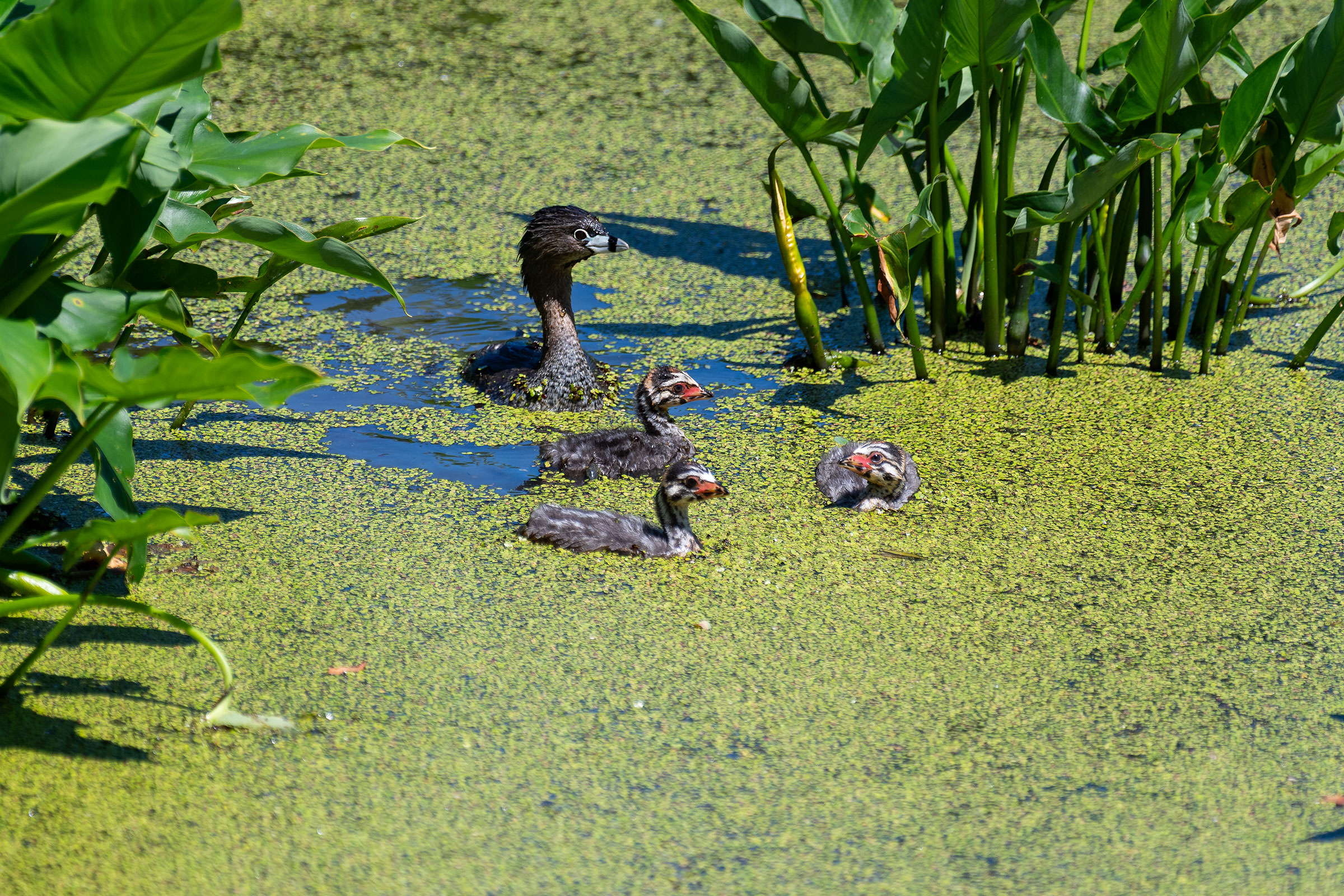
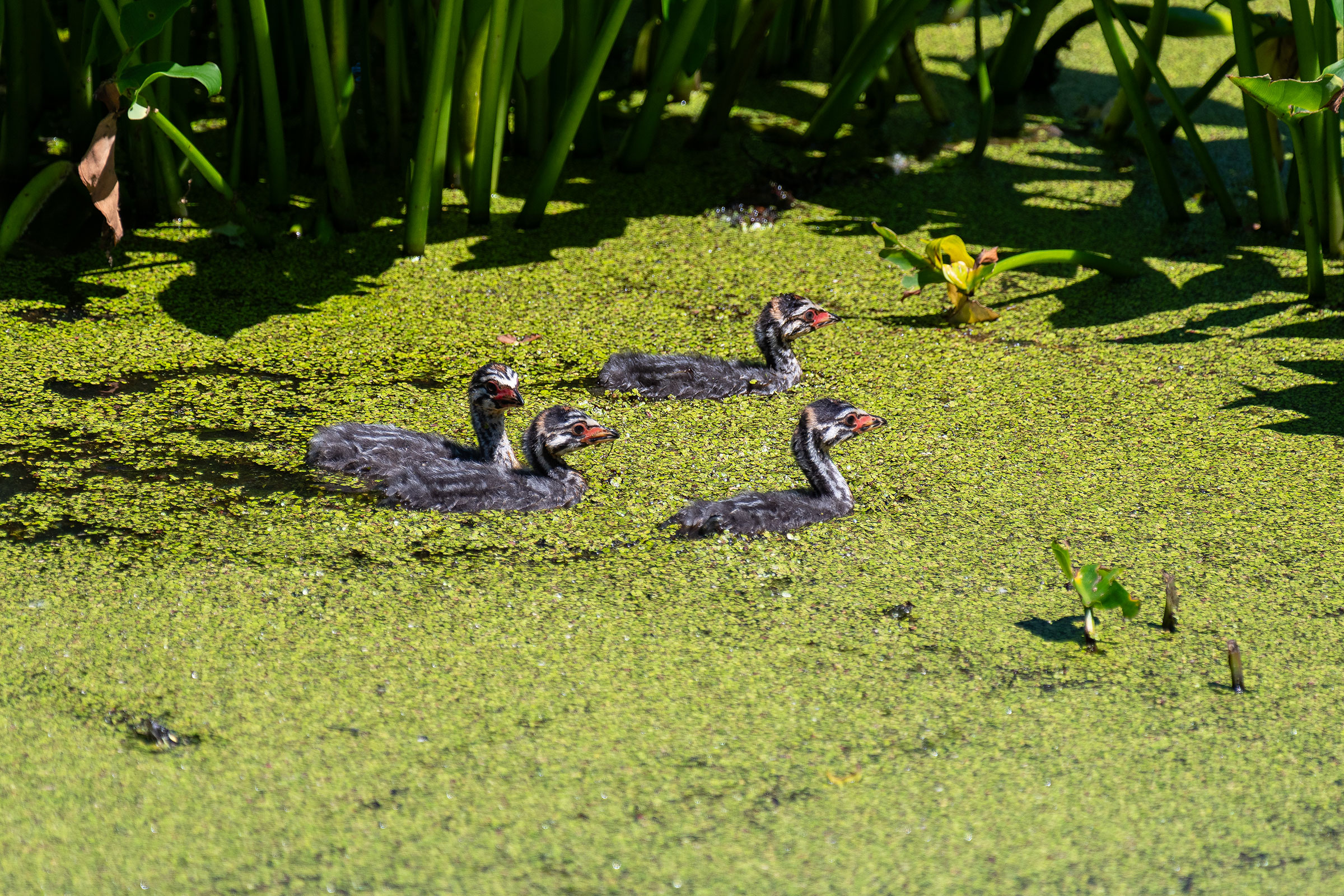
Pied-billed Grebes were confirmed breeders in just two blocks: Dutch Gap Conservation Area in Chesterfield County (feeding young, May 29) and Back Bay National Wildlife Refuge in Virginia Beach (occupied nest and recently fledged young on June 22 and July 7, respectively) (Figures 1 and 3). In addition, there were 10 reports of possible breeders in nine blocks, consisting of individuals observed in suitable habitat (ponds, reservoirs, and impoundments) at sites in the Coastal Plain, northern Piedmont and Mountains and Valleys regions (Figure 1). Despite lower survey effort during the First Atlas, the species was reported from over twice as many blocks as it was during the Second Atlas (Figure 2).
For more general information on the breeding habits of this species, please refer to All About Birds.
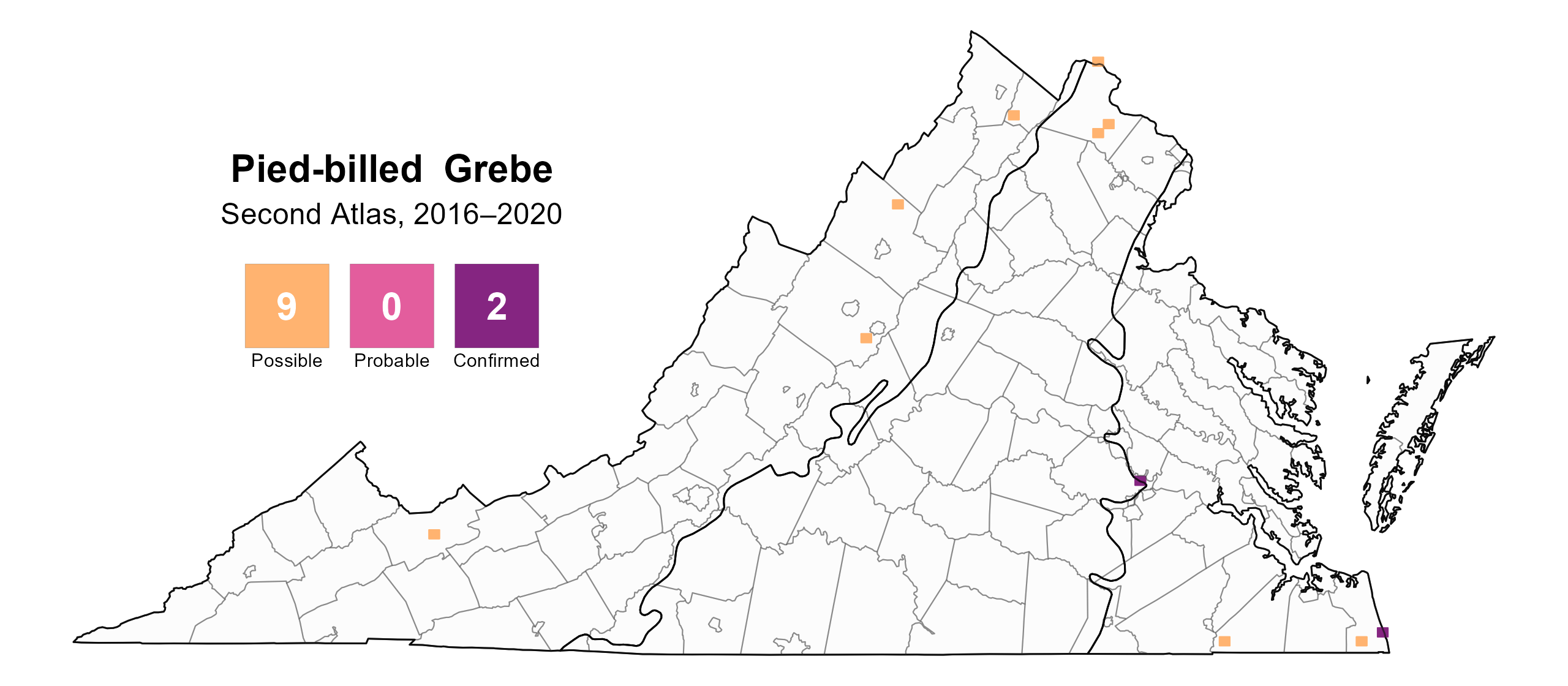
Figure 1: Pied-billed Grebe breeding observations from the Second Atlas (2016–2020). The colored boxes illustrate Atlas blocks (approximately 10 mi2 [26 km2] survey units) where the species was detected. The colors show the highest breeding category recorded in a block. The numbers within the colors in the legend correspond to the number of blocks with that breeding evidence category.
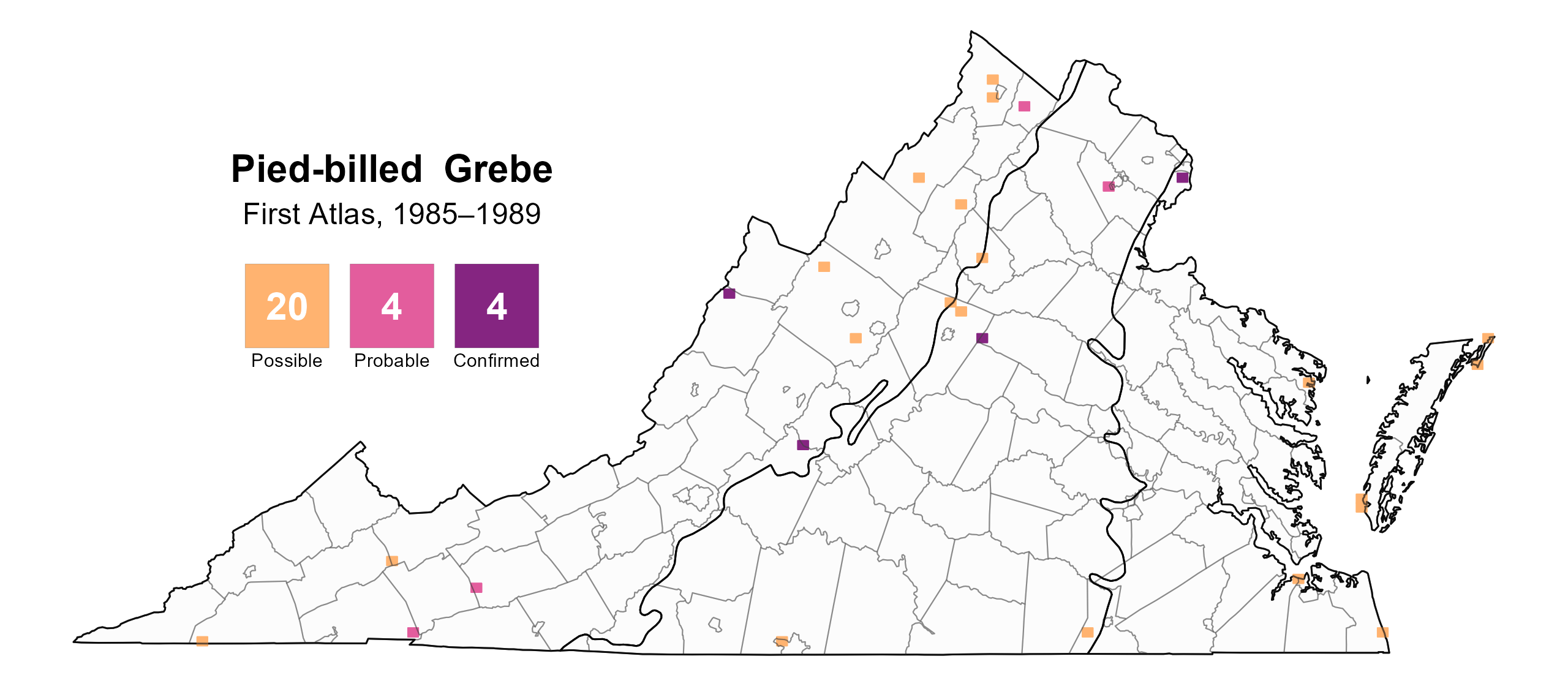
Figure 2: Pied-billed Grebe breeding observations from the First Atlas (1985–1989). The colored boxes illustrate Atlas blocks (approximately 10 mi2 [26 km2] survey units) where the species was detected. The colors show the highest breeding category recorded in a block. The numbers within the colors in the legend correspond to the number of blocks with that breeding evidence category.
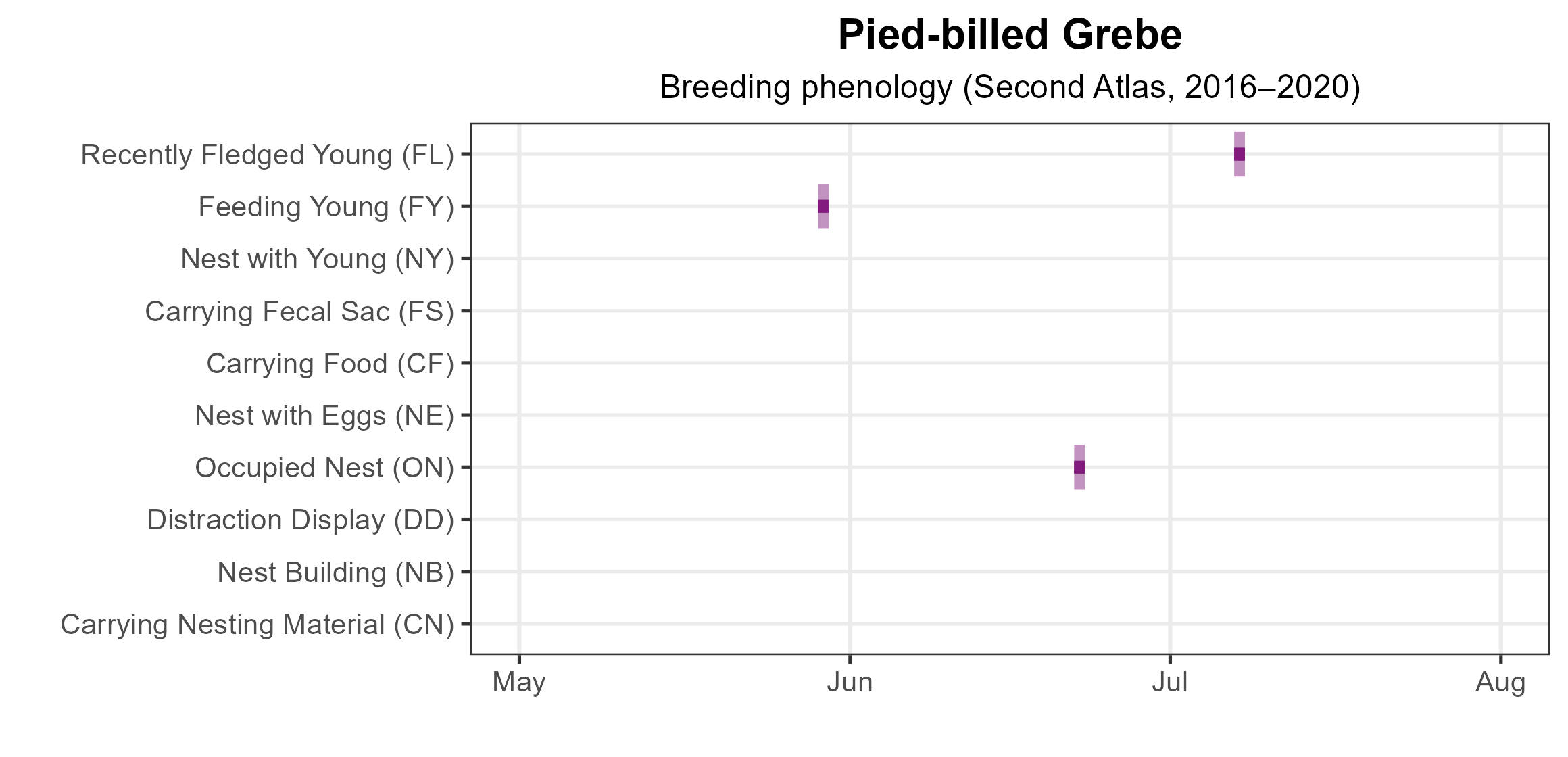
Figure 3: Pied-billed Grebe phenology: confirmed breeding codes. This graph shows a timeline of confirmed breeding behaviors. Tick marks represent individual observations of the behavior.
Population Status
Pied-billed Grebes were not detected on Atlas point count surveys, and an abundance model could not be developed. Similarly, this species is documented at low abundances on relatively few routes of the North American Breeding Bird Survey (BBS), so credible population trends could not be estimated at any geographic scale (Hostetler et al. 2023). Despite fewer reports of the species during the Second Atlas than the First Atlas (see Breeding Evidence section), there are not enough data from which to draw inferences on population trends.
Conservation
Due to a small, widely scattered breeding population in Virginia, with breeding individuals difficult to detect, details on the Pied-billed Grebe’s breeding ecology and true distribution in the Commonwealth remain elusive. Owing to this and its status as an edge-of-range breeder in Virginia, additions to the body of knowledge of the species in Virginia will likely result from the accumulation of reports by individual observers, rather than from any systematic surveys targeting the species. As part of the broader marsh-dependent bird community, Pied-billed Grebes will benefit from actions taken to conserve marshlands, whether they be through protection, management, or restoration.
Interactive Map
The interactive map contains up to six Atlas layers (probability of occurrence for the First and Second Atlases, change in probability of occurrence between Atlases, breeding evidence for the First and Second Atlases, and abundance for the Second Atlas) that can be viewed one at a time. To view an Atlas map layer, mouse over the layer box in the upper left. County lines and physiographic regional boundaries (Mountains and Valleys, Piedmont, and Coastal Plain) can be turned on and off by checking or unchecking the box below the layer box. Within the map window, users can hover on a block to see its value for each layer and pan and zoom to see roads, towns, and other features of interest that are visible beneath a selected layer.
View Interactive Map in Full Screen
References
Muller, M. J. and R. W. Storer (2020). Pied-billed Grebe (Podilymbus podiceps), version 1.0. In Birds of the World (A. F. Poole and F. B. Gill, Editors). Cornell Lab of Ornithology, Ithaca, NY, USA. https://doi.org/10.2173/bow.pibgre.01.
Hostetler, J. A., J. R. Sauer, J. E. Hines, D. Ziolkowski, and M. Lutmerding (2023). The North American breeding bird survey, analysis results 1966 – 2022. U.S. Geological Survey, Laurel, MD, USA. https://doi.org/10.5066/P9SC7T11.
Rottenborn, S.C., and E.S. Brinkley (2007). Virginia’s birdlife: an annotated checklist. 4th edition. Virginia Society of Ornithology.
Wilson, M.D., B.D. Watts, and D.F. Brinker (2007). Status review of Chesapeake Bay marsh lands and breeding marsh birds. Waterbirds 30:122–137. https://doi.org/10.1675/1524-4695.